Signs Your Concrete Needs Leveling
Most settled slabs announce themselves months before anyone calls. A lip at a joint, a hollow sound underfoot, water pooling where it never used to. Here is the full list and what each one actually means.
A slab needs levelling when it has dropped relative to its neighbours or to a fixed structure and sounds hollow when tapped. Those two observations together confirm a void underneath, and a void is what levelling fills. Everything else on this page is either supporting evidence or a way of telling settlement apart from problems that lifting will not fix.
Acting early is worth money here. An inch of settlement on sound concrete is a straightforward lift. The same slab left to be driven over with a cavity beneath it bends across the edge of that cavity on every axle pass until it cracks, and a cracked slab may become a replacement instead.
Nine signs a slab has settled
You can check every one of these yourself in ten minutes with nothing but a hammer handle and a hose.
A lip at a joint
One panel sits lower than its neighbour, leaving a vertical step. Over half an inch is a recognised trip hazard. This is the most common and most actionable sign, and it is the one that most often turns into a liability question on a public walk.
It sounds hollow
Tap the slab with a hammer handle or a heavy screwdriver. Sound concrete on soil gives a dull thud. A void underneath rings noticeably hollow. Walk a driveway tapping every few feet and you can usually map the cavity before anyone drills anything.
Water pools where it did not
A slab that has dropped in the middle or tilted back toward the house collects water after rain or irrigation. New puddling on old concrete is settlement until proven otherwise, and the puddle then accelerates the problem by delivering more water to the same spot.
A gap at the house or step
A visible separation opening between a patio and the house wall, or between a driveway and the garage threshold, means the flatwork has moved away from a structure that has not. The gap also becomes a direct water entry point into the subgrade.
Doors and gates catch
A gate that used to swing clear now drags on the concrete, or a garage door meets the slab unevenly along its width. Both indicate the slab has changed elevation relative to fixed structures rather than the structures having moved.
Cracks that step at a joint
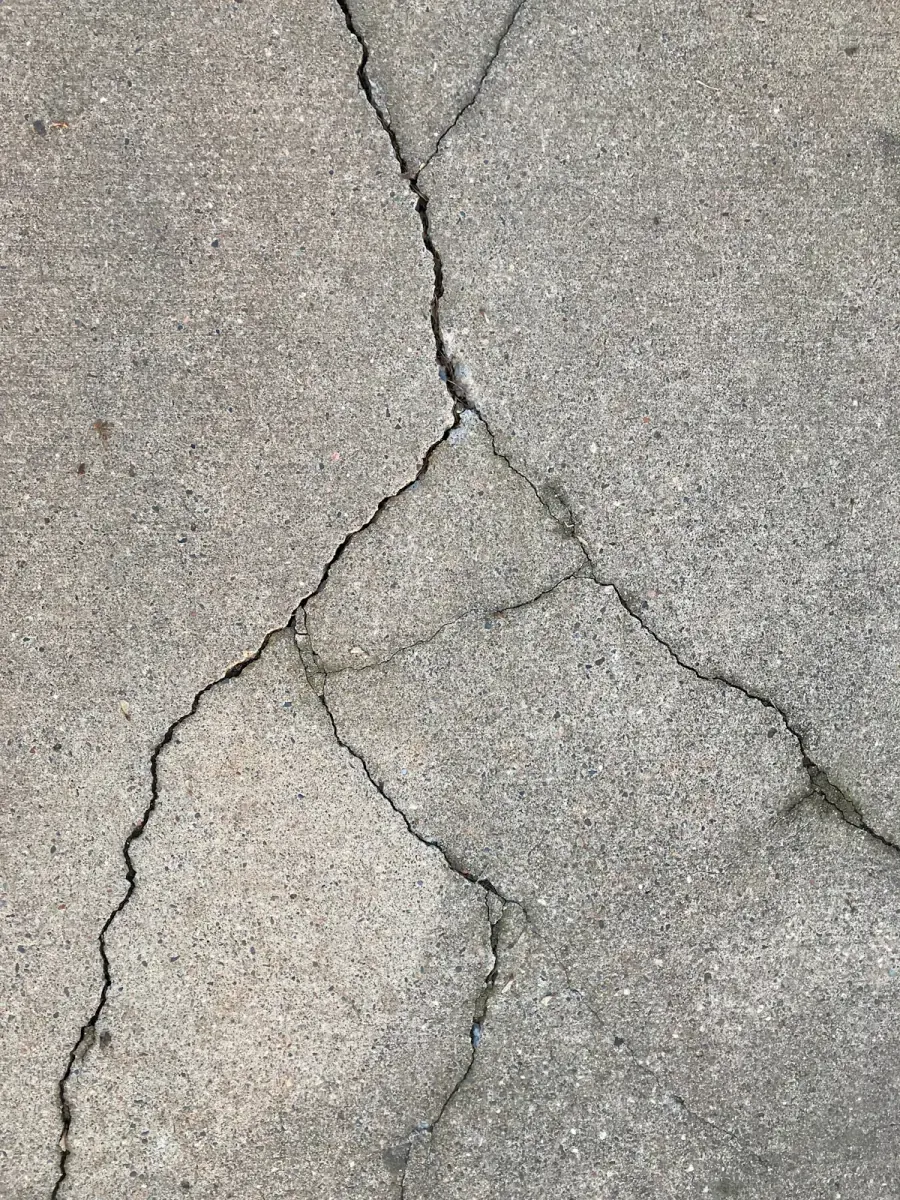
A crack where the two sides are at different heights is a movement crack rather than a shrinkage crack. Shrinkage cracks are flat across. Any vertical offset across a crack means one side has lost support, and that is a settlement signature.
Soil washing out at an edge
Visible erosion channels or a gap under the slab edge, often at the approach or beside a downspout. If you can see daylight under an edge, there is a cavity under the middle. This is the earliest visible stage and the cheapest to correct.
A rocking or springy slab
Step onto a panel and feel it move, or notice a vehicle rock as it crosses a section of driveway. Movement under load means the slab is bridging a void rather than bearing on soil, and that is when cracking becomes likely.
Mulch or gravel disappearing
Landscape material next to a slab that keeps vanishing is being carried into a void beneath it. It is an unglamorous sign and a reliable one, and it usually points at exactly where the water is entering.
The hollow tap test, done properly
Tap the slab with a hammer handle or the butt of a heavy screwdriver. Concrete bearing on soil returns a dull, dead thud. Concrete bridging a void rings noticeably hollow, and the difference is obvious once you have heard both within a few feet of each other.
Walk the slab tapping every two or three feet and mark the hollow areas with chalk. What you end up with is a rough map of the cavity, and it is frequently larger than the visibly sunken area, because a void opens before the slab has dropped far enough to see. That gap between what you can see and what is actually under there is why quoting from the kerb produces wrong numbers.
Settlement or heave, and why it changes everything
Settling is the slab dropping because support was lost. Heaving is the slab rising because something beneath it expanded or grew. Lifting corrects the first and does nothing useful for the second, so getting this right before spending money matters.
The test is which side of a joint is high and whether it sounds hollow. A settled section sits low relative to its neighbour and rings hollow. A heaved section sits proud and sounds solid, because there is more material under it, not less. On mature streets in Lubbock and Slaton, tree root heave is the usual cause and lifting the surrounding panels to match is a temporary fix at best.
Why Lubbock slabs settle rather than heave
Most of Lubbock sits on Amarillo fine sandy loam and Acuff loam, well drained sandy soils formed in the loamy eolian deposits of the Blackwater Draw Formation, over a calcic caliche horizon roughly 30 to 60 inches down. Water infiltrates readily, reaches that cemented layer, and moves sideways, carrying fine particles out from under slabs as it goes.
That makes this a washout market rather than a heave market. The expansive-clay story that dominates Dallas and Houston content does not describe what happens on most Lubbock lots. Around 19 inches of rain a year arriving in a handful of intense storms, with long dry spells between, produces a cycle of shrink, saturate, wash and collapse.
The exception is real and worth knowing. On playa margins the soil is Randall clay, a very-fine smectitic clay that is poorly drained and frequently ponded for long periods, with slickensides and high shrink-swell behaviour. Lots on or draining toward a playa rim genuinely do heave as well as settle, and they need drainage in the scope.

What is actually causing it
Downspout discharge. The most common cause on a Lubbock lot and the cheapest to fix. An inch of rain on a 1,500 square foot roof is roughly 900 gallons, and even split four ways that puts hundreds of gallons into one patch of sandy soil. Extending the downspout past the slab edge costs almost nothing.
Uncompacted fill. Common on newer subdivisions and over utility trenches. Fill continues consolidating for years as moisture cycles through it, and a slab poured on it rides it down. This is why newer Wolfforth homes see settlement so early in their life.
Grade falling toward the structure. If the soil next to the house slopes back rather than away, every rain delivers water to the foundation backfill, which is the most disturbed soil on the lot.
Irrigation. Heads watering the edge of a slab rather than the lawn, or a leaking service line, deliver repeated saturation to one spot with no seasonal break.
An under-slab plumbing leak. Less common but the most urgent to identify. A supply leak erodes subgrade continuously, and lifting a slab over an active leak is money spent twice. Unexplained damp, a rising water bill or a warm spot on a floor all warrant a leak test before any levelling work.
A void that formed because water is being delivered to one spot will re-form after any lift, foam or slurry, if that delivery continues. This is the single most useful thing on this page. Every written scope we issue names the water source we observed, whether or not correcting it is in our scope, because a repair that re-opens helps nobody.
Signs that are not settlement
Three things get mistaken for it regularly. Surface spalling and scaling, where the wearing surface flakes away, is freeze-thaw and finishing damage rather than movement, and levelling does not touch it. Flat shrinkage cracks with no vertical offset across them are normal curing behaviour and not a structural signal. And discolouration or efflorescence is a moisture and chemistry issue on the surface, not evidence of a void.
The distinguishing question is always the same: is there a height difference, and does it sound hollow? No height difference and no hollow sound means whatever is wrong with the slab is not something injecting material underneath will fix, and we will tell you that rather than sell you a lift.
When to have the house foundation looked at instead
Flatwork settling is normally independent of the house, because a driveway is unreinforced concrete on subgrade while a foundation is an engineered reinforced slab. But if the settlement runs right up to the house and you are also seeing interior drywall cracks at door corners, doors and windows sticking, or a visible slope on an interior floor, those are foundation symptoms and belong to a different assessment. We will say so rather than quote flatwork and leave it. The distinction is covered on the foundation slab levelling page.
What happens next
If two or more of the nine signs describe your slab, a written assessment will confirm it in about half an hour. We shoot laser elevations, tap out the void extent, core-measure thickness at the first port, and identify the water source. You get the measured drop, the estimated material volume, both methods priced, and an honest verdict on whether the slab should be lifted or replaced. There is no charge and no obligation, and typical costs are laid out on the cost page. Send the details through the contact form and the reply comes back in writing.
If you want to check the ground under your own address before you call anyone, the USDA publishes the mapped soil series for every parcel in Lubbock County. The Web Soil Survey will tell you whether you are on upland Amarillo or Acuff soils, where settlement is the failure mode, or on Randall clay in a playa basin, where the slab may be heaving as well as dropping.
Concrete settlement questions
How do I know if my slab has settled?
The clearest test is relative height at a joint: a settled section sits lower than its neighbour and usually sounds hollow when you tap it with a hammer handle, because there is a void underneath. Other reliable signs are water pooling where it never used to, a gap opening between a slab and the house or a step, and doors or gates that now catch on concrete they used to clear.
What is the difference between settling and heaving?
Settling is the slab dropping because support beneath it was lost. Heaving is the slab rising because something beneath it expanded or grew. The visual test is which side of a joint is high and whether it sounds hollow: settled sections sit low and often ring hollow, heaved sections sit proud and sound solid. Lifting fixes settlement. Heave needs the cause removed instead.
Why is my driveway sinking?
Most Lubbock driveways sink because water has washed fine particles out of the sandy subgrade beneath them, leaving voids that eventually collapse. Our soils are Amarillo fine sandy loam and Acuff loam over a calcic caliche horizon 30 to 60 inches down, so water infiltrates, hits that cemented layer, then runs sideways carrying fines. Downspouts and the approach at the street concentrate that flow.
Why does concrete sink near downspouts?
Concrete sinks near downspouts because a downspout concentrates the runoff from a large roof area into one small patch of soil. A single inch of rain on a 1,500 square foot roof is roughly 900 gallons, and dividing that across four downspouts still puts hundreds of gallons into one spot. On sandy subgrade that repeated flow migrates fines and opens a void faster than anything else on a typical lot.
Is a sinking driveway a foundation problem?
Usually not. Driveways, patios and sidewalks are unreinforced flatwork poured directly on the subgrade, while a house foundation is an engineered reinforced slab designed for the load. Flatwork settles first because it is the weakest concrete on the lot, which makes it an early warning rather than a symptom. If settlement runs right up to the house and you also see interior cracks or sticking doors, have the foundation assessed separately.
Can tree roots lift a sidewalk?
Yes, and root heave is one of the few causes that lifting does not solve. A root growing under a panel raises it, so the panel sits proud and sounds solid rather than hollow. Raising the neighbouring panels to match is a temporary fix that will be out of level again as the root grows. Those jobs need the panel cut out and the root managed.
What causes concrete to settle?
Four causes cover almost all of it. Water washing fines out of the subgrade, which is the dominant mechanism in Lubbock. Fill that was never properly compacted, common on newer subdivisions and over utility trenches. Soil shrinkage in long dry spells, especially on heavier clay. And erosion from a plumbing leak under the slab, which is less common but the most urgent to identify.
How much drop is too much to ignore?
Any vertical lip over half an inch at a walking surface is a recognised trip hazard and worth correcting on safety grounds alone. Beyond that, the argument for acting early is financial: an inch of settlement on sound concrete is a straightforward lift, while the same slab left to be driven over with a void beneath it frequently cracks, and a cracked slab may become a replacement.
Does it have to be dry to level concrete?
The slab surface should be dry enough to patch cleanly, but the ground does not need to be dry and levelling is not a seasonal service. Polyurethane foam is hydro-insensitive and cures by chemical reaction, so it works in cold and damp conditions. What we avoid is lifting during active saturation, because the subgrade is at its softest and the measured elevations are least representative.
Get it measured, free
Send us what you are seeing. We shoot elevations, map the void by tapping, core-measure thickness and name the water source, then tell you whether lifting is the right answer at all.
- Free written scope with a measured lift plan, not a verbal number
- Polyurethane foam on 5/8 inch holes, patched and colour matched
- Drive on the slab the same day, usually within the hour
- Insured crews, written workmanship guarantee on every lift