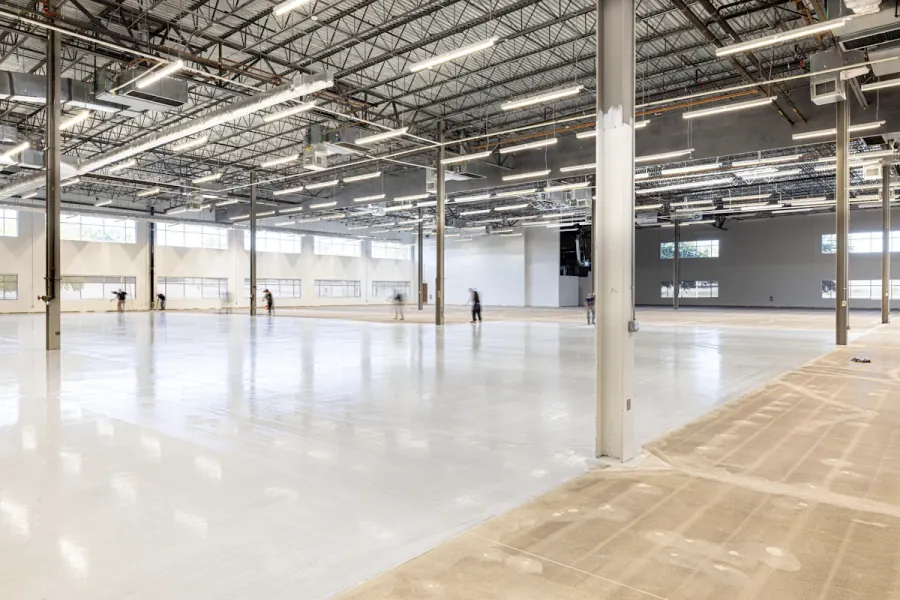
Commercial Concrete Leveling in Lubbock, TX
Warehouse floors, dock approaches, parking slabs and trip-hazard walkways lifted without closing the building. Forklift traffic returns within the hour, and the work is scoped zone by zone so only one area is ever out of service.
Commercial concrete leveling lifts a settled industrial or retail slab back to grade through 5/8 inch injection ports, and in Lubbock it costs $5 to $12 per square foot with polyurethane foam against $18 to $30 per square foot to demolish and repour. A 2,000 square foot warehouse bay typically runs $10,000 to $24,000 to lift and $36,000 to $60,000 to replace.
The number that usually decides it is not the unit price though. It is downtime. Replacing a warehouse bay means clearing racking, demolition, haul-off, base work, a pour, and cure time before load, which realistically shuts that footprint for three to six weeks. A foam lift in the same bay runs overnight and takes loaded forklifts at the start of the next shift.
Where commercial slabs fail in Lubbock
Dock approaches fail first, and for a clear reason: they combine the heaviest repeated loading on the site with the most disturbed fill. The approach pad is built on material placed to create the grade change at the dock, and then every loaded trailer that backs in delivers axle loads onto it. Concentrate roof and yard runoff at the same apron, which most dock designs do, and the sandy subgrade starts moving.
The Lubbock soil picture explains the speed of it. The uplands here are Amarillo fine sandy loam and Acuff loam, well drained and moderately permeable over a calcic caliche horizon 30 to 60 inches down. The city receives around 19 inches of rain a year, delivered in a handful of intense convective storms rather than spread evenly. Water soaks through the sand, hits the cemented caliche, and runs laterally, taking fines with it wherever flow is concentrated. Industrial sites, with their large impervious roofs and paved yards, concentrate flow by definition.
The four commercial jobs we see most
Warehouse floor joints and aisles. A settled panel at a joint destroys forklift wheels and shakes loads. Lifting restores joint continuity without taking racking apart.
Dock approaches and aprons. The highest-value fix on most industrial sites, because a dropped approach eventually stops trailers seating correctly against the seal.
Parking areas and drive lanes. Settled lanes pond water, and ponded water on a sandy Lubbock subgrade accelerates the next drop. These lift fast and cheaply per square foot because the areas are large and contiguous.
Public-facing walkways. Trip hazards on a pedestrian route are both a liability and an accessibility problem. Lifting a settled panel back into tolerance avoids closing the frontage and avoids the City permit that replacing a public sidewalk triggers. Smaller runs are covered on the sidewalk leveling page.
How a commercial lift is run
Scoped by zone, sequenced around your operating schedule, with before and after elevation surveys handed over as documentation.
- 1
Walk the site with operations, not just facilities
We map the slab against how the building is actually used: which aisles carry forklift traffic, which doors cannot close, when trailers arrive. The lift sequence is built around that schedule, because a technically perfect plan that shuts a dock during receiving is not a plan.
- 2
Survey and sound the slab
Laser elevations across the affected area plus acoustic sounding to map where voids actually sit. On a large slab the lowest point and the biggest cavity are usually in different places, and pouring material into the low spot without finding the cavity wastes both.
- 3
Scope by zone with a fixed price per zone
The written scope divides the area into working zones, each with its own port count, target elevation and price. That lets you stage the work across budget periods or shut only one zone at a time, and it makes the quote auditable rather than a single lump number.
- 4
Fill voids and stabilise subgrade
Injection starts as soil work. Cavities are filled and loose subgrade is consolidated until it can carry design loads again. On dock approaches and heavily trafficked aisles this stage is the job, and the visible lift is a secondary outcome.
- 5
Lift under load monitoring
Slabs are raised in small increments with elevations monitored continuously, and with racking, machine bases and door tracks watched directly where they are affected. We stop at the target elevation and at the tolerance the equipment needs, whichever is tighter.
- 6
Patch, verify and return to service
Ports are patched flush so forklift wheels and pallet jacks pass over them without catching. We re-shoot the finished elevations, hand over the before and after survey, and the zone goes back into service the same shift.
Commercial concrete leveling cost in Lubbock
Commercial lifting is priced per square foot with a floor for mobilisation, and larger contiguous areas land toward the bottom of the range. Mudjacking remains genuinely competitive on thick, well-supported industrial slabs where added slurry weight is not a concern, which is one of the few places it still earns its place.
| Area | Size | Foam injection | Replace |
|---|---|---|---|
| Dock approach pad | 400 sq ft | $2,400 to $4,800 | $8,000 to $14,000 |
| Warehouse bay | 2,000 sq ft | $10,000 to $24,000 | $36,000 to $60,000 |
| Warehouse floor, full | 10,000 sq ft | $50,000 to $110,000 | $180,000 to $300,000 |
| Parking drive lane | 3,000 sq ft | $13,500 to $30,000 | $48,000 to $84,000 |
| Storefront walkway | 300 sq ft | $1,500 to $3,400 | $5,400 to $9,000 |
| Void fill, no lift | Per cubic foot of cavity | Quoted by volume | Not applicable |
Night and weekend scheduling is available at standard rates on scopes above 1,000 square feet. Before and after laser elevation surveys are included on all commercial work and handed over as part of the close-out.
A six-inch industrial slab over compacted structural fill is a genuinely different situation from a four-inch residential driveway over washed-out sand. The slab is stiff enough to distribute load and the subgrade was engineered to carry it, so the 100 to 150 pounds per cubic foot that a cement slurry adds is not the deciding factor it is on a pool deck. Where budget is the constraint and the subgrade is sound, mudjacking a warehouse slab is a defensible call and we will quote it. The full comparison is on the method comparison page.
Documentation, insurance and registration
Commercial clients need paperwork, and the paperwork in Texas concrete work is narrower than people expect. There is no state general contractor licence and no statewide exam or bond. What exists is City of Lubbock contractor registration, which requires proof of general liability insurance of at least $100,000 or a $20,000 compliance bond, and that registration is a requirement for any building or general contractor performing work in the City.
On top of that we hand over before and after laser elevation surveys for every commercial scope, a zone-by-zone record of material placed, and a written statement of the drainage conditions observed on site. That last document matters more than it sounds: it is what tells your facilities team whether the repair is expected to hold or whether a gutter and grading scope has to follow it.
Working across Lubbock, Hockley and Hale counties
Commercial work runs across the same three-county footprint as residential. That includes industrial and agricultural facilities around Levelland in Hockley County, where county agricultural income runs around $71 million a year with roughly 70 percent from crops and significant petroleum production alongside it, and commercial and municipal flatwork in Plainview, the Hale County seat with a 2020 population of 20,187. Both see heavy equipment on slabs poured for lighter duty, which is a common origin for localised settlement.
Commercial concrete leveling questions
Can commercial warehouse floors be leveled?
Yes, and lifting is usually the only practical option because replacing a warehouse slab means shutting the bay down for weeks. Polyurethane foam injection lifts a settled warehouse floor through 5/8 inch ports with racking in place, and the area takes forklift traffic within an hour of the last injection. Lubbock commercial slab work typically runs $5 to $12 per square foot against $18 to $30 for tear-out and replacement.
How much downtime does commercial concrete leveling need?
Usually none beyond the immediate working area. Foam cures to roughly 90 percent strength in about 15 minutes, so a bay lifted in the morning carries loaded forklifts by lunch. We sequence by aisle or by bay so the rest of the facility keeps running, and night and weekend work is standard on retail and food service sites where daytime access is not possible.
What does commercial concrete leveling cost per square foot?
Commercial concrete leveling in Lubbock runs $5 to $12 per square foot with polyurethane foam and $3 to $8 with mudjacking. Larger contiguous areas price toward the lower end because mobilisation is amortised over more square footage. A 2,000 square foot warehouse bay typically lands between $10,000 and $24,000 with foam, against $36,000 to $60,000 to demolish and repour the same area.
Can you lift a slab around racking and equipment?
Yes. Ports are 5/8 inch and can be placed within inches of a rack leg, so pallet racking generally stays bolted down and loaded. Fixed equipment, conveyor lines and machine bases are worked around with adjusted port spacing. Where a machine base has to hold tight tolerance, we monitor it directly during the lift rather than relying on slab elevations alone.
Why do dock approaches settle first?
Dock approaches settle first because they carry the heaviest repeated loading on the property over the most disturbed fill. The approach pad sits on material placed during construction to build the grade change at the dock, and every loaded trailer that backs in puts axle loads on it. Add concentrated roof and yard runoff at the dock apron and Lubbock's sandy Amarillo and Acuff subgrades, and the fines migrate quickly.
Is a trip hazard on commercial property a compliance issue?
Yes. An uneven panel on a pedestrian route is both a liability exposure and an accessibility problem, because accessible routes have tightly specified running slope, cross slope and vertical level change limits. Lifting a settled panel back into tolerance is typically faster and far less disruptive than closing the route for demolition and a pour, and it avoids the City permit that replacing public-facing sidewalk triggers.
Do commercial slab lifts need a permit in Lubbock?
Lifting an existing slab in place is a repair and generally does not require a City of Lubbock permit, while replacing sidewalk, driveway approach, or curb and gutter on a public street does. Any contractor performing building work in the City must be registered, which requires $100,000 general liability or a $20,000 compliance bond. For commercial clients that registration plus a current certificate of insurance is the baseline to ask for.
How long does a commercial lift last?
Ten to fifteen years is the normal expectation for a foam lift, and the limiting factor is the soil, not the material. Cured polyurethane does not wash out, dissolve, compress under load or attract pests, so it is stable indefinitely. What ends the repair is the same thing that caused it: ongoing water movement under the slab. Commercial scopes that include drainage correction reliably outlast those that do not.
Get a commercial scope and price
Send the address, the affected area and your operating hours. We survey the slab, break the work into zones, and come back with a fixed price per zone plus a sequence that keeps the rest of the building running.
- Free written scope with a measured lift plan, not a verbal number
- Polyurethane foam on 5/8 inch holes, patched and colour matched
- Drive on the slab the same day, usually within the hour
- Insured crews, written workmanship guarantee on every lift