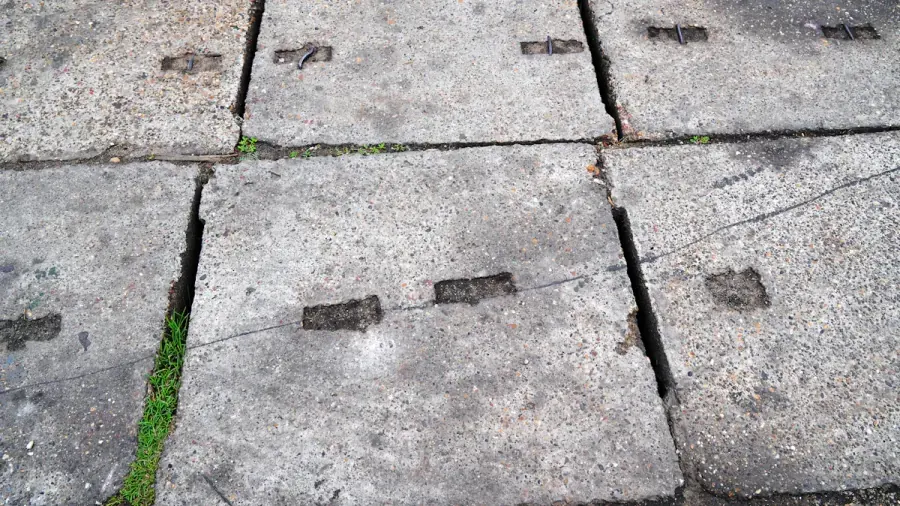
Concrete Leveling in Lubbock, TX
We lift sunken driveways, sidewalks, patios, pool decks, garage floors and interior slabs back to grade with polyurethane foam injection, from $500. Most jobs are finished in one visit and you drive on the slab the same day. Free written quote, with the scope and the number in writing before anything gets drilled.
- From $500 for a single-panel lift
- 5/8 inch ports, colour-matched patches
- Drive on it the same day
- 40 to 70 percent below replacement
What concrete leveling actually is, and what it costs here
Concrete leveling raises a slab that has dropped back to its original elevation by filling the void underneath it, and in Lubbock it costs $3 to $8 per square foot with mudjacking or $5 to $12 per square foot with polyurethane foam. Nothing is demolished, nothing is repoured, and the surface you already have is the surface you keep. A small single-panel lift starts around $500. A settled two-car driveway typically runs $1,200 to $3,500.
The reason it works is that a sunken slab is almost never a broken slab. Drive around Tech Terrace or LakeRidge and look at the dropped driveway aprons and the lipped sidewalk panels: the concrete is intact, often decades old and still sound. What failed is the few inches of soil under it. Once that void is filled and the loose material around it is consolidated, the slab goes back where it started and carries load again.
That is also why replacement is usually the wrong first answer. Tearing out a driveway means demolition, haul-off, new base, forms, concrete, and a week where you park on the street. It costs three to four times as much as lifting, and if the drainage problem that caused the settlement is still there, the new slab starts its own countdown the day it cures.
Why slabs sink on the Llano Estacado
Lubbock slabs sink mostly because water washes the fine sand out from under them, not because the soil swells and shrinks the way it does in Dallas or Houston. The city sits at 3,202 feet on the Llano Estacado, on loamy eolian deposits of the Blackwater Draw Formation. The dominant series are Amarillo fine sandy loam and Acuff loam, both with a calcic horizon, the caliche caprock, sitting 30 to 60 inches down.
Lubbock gets about 19 inches of rain a year, but it does not arrive evenly. It arrives as a handful of intense convective storms. Water soaks through the sandy upper profile, hits the cemented caliche, and travels laterally instead of down. Anywhere that flow is concentrated, at a downspout discharge, at a driveway approach, along a poorly graded side yard, it carries the fine fraction of the soil with it. The result is a cavity under an otherwise perfect slab.
Olton clay loam, common on the flatter uplands, adds a second mechanism. It runs 35 to 50 percent silicate clay with moderately slow permeability, so water perches under a slab rather than draining through, saturating and softening the bearing layer until the slab punches down into it.

If your lot drains toward a playa, the soil is different
Homes on or near a playa rim sit on Randall clay, which behaves nothing like the upland soils two blocks away. Randall is a very-fine, smectitic, thermic Ustic Epiaquert: poorly drained, very slowly permeable, and frequently ponded for long periods in most years. Smectitic means high shrink-swell. It is the one soil in this county that genuinely heaves.
Lubbock has more than a hundred playa basins, many of them absorbed into city parks and used as municipal stormwater detention. That is deliberate and it works, but it means a large number of residential lots grade toward one. The Texas Water Development Board measures playa infiltration at 0.04 to over 0.8 inches per day, and notes that rapid infiltration through cracks only affects the upper six feet of the profile. In plain terms: water sits.
A slab on that ground can rise after a wet season and drop after a dry one, and the corner nearest the basin moves most. Lifting it without reading the drainage is how a contractor ends up back on the same driveway in two years. We shoot elevations and check where the lot sends its water before quoting anything.

The dropped driveway approach
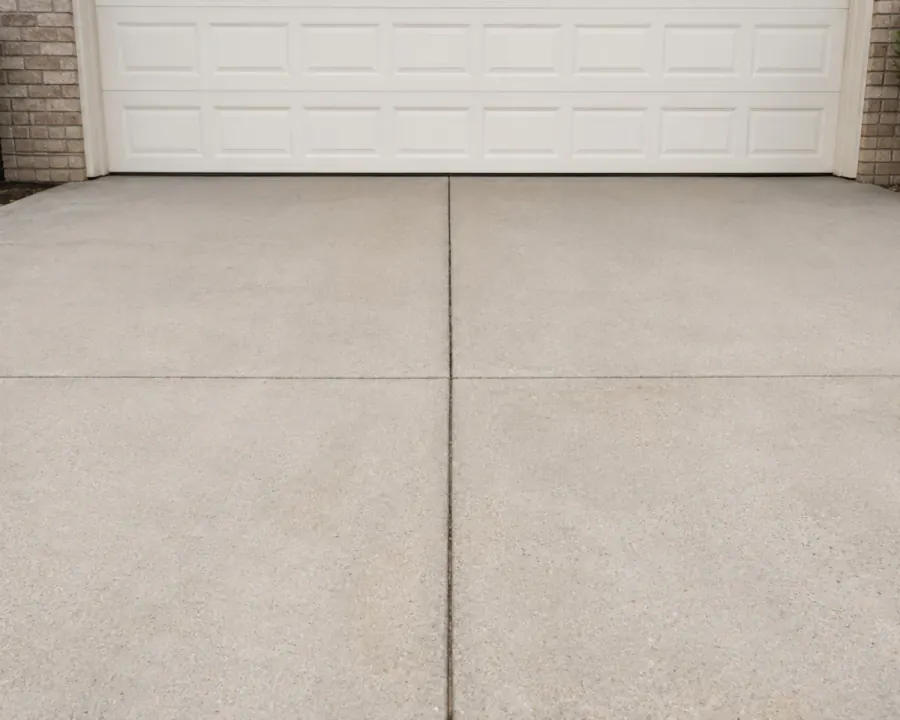
The single most common Lubbock job is a driveway approach that has dropped an inch or two at the street or at the garage door. You feel it as a bump getting in and out, and eventually you see a gap under the panel edge. It happens there because the approach is where the most water runs and where the base was most disturbed during construction.
Left alone, it gets worse in a specific way: the lip becomes a dam, water pools behind it, and the pooling accelerates the washout that caused the drop. Lifting early costs less because the void is smaller and needs less material to fill.
The tripping-hazard sidewalk
A sidewalk panel that has lifted or dropped more than half an inch at a joint is a liability, and in older parts of town it is everywhere. Tech Terrace was platted in 1925 and Slaton's townsite grid dates to 1911, so a lot of the walkways in those blocks are running on their original pour over a century of wet and dry cycles.
Lifting a sidewalk panel takes under an hour and costs a fraction of replacing it, and it avoids the permit that a public sidewalk replacement triggers. Tree roots are the one case where lifting alone will not hold, because the root keeps growing.
The patio and pool deck that now drains the wrong way
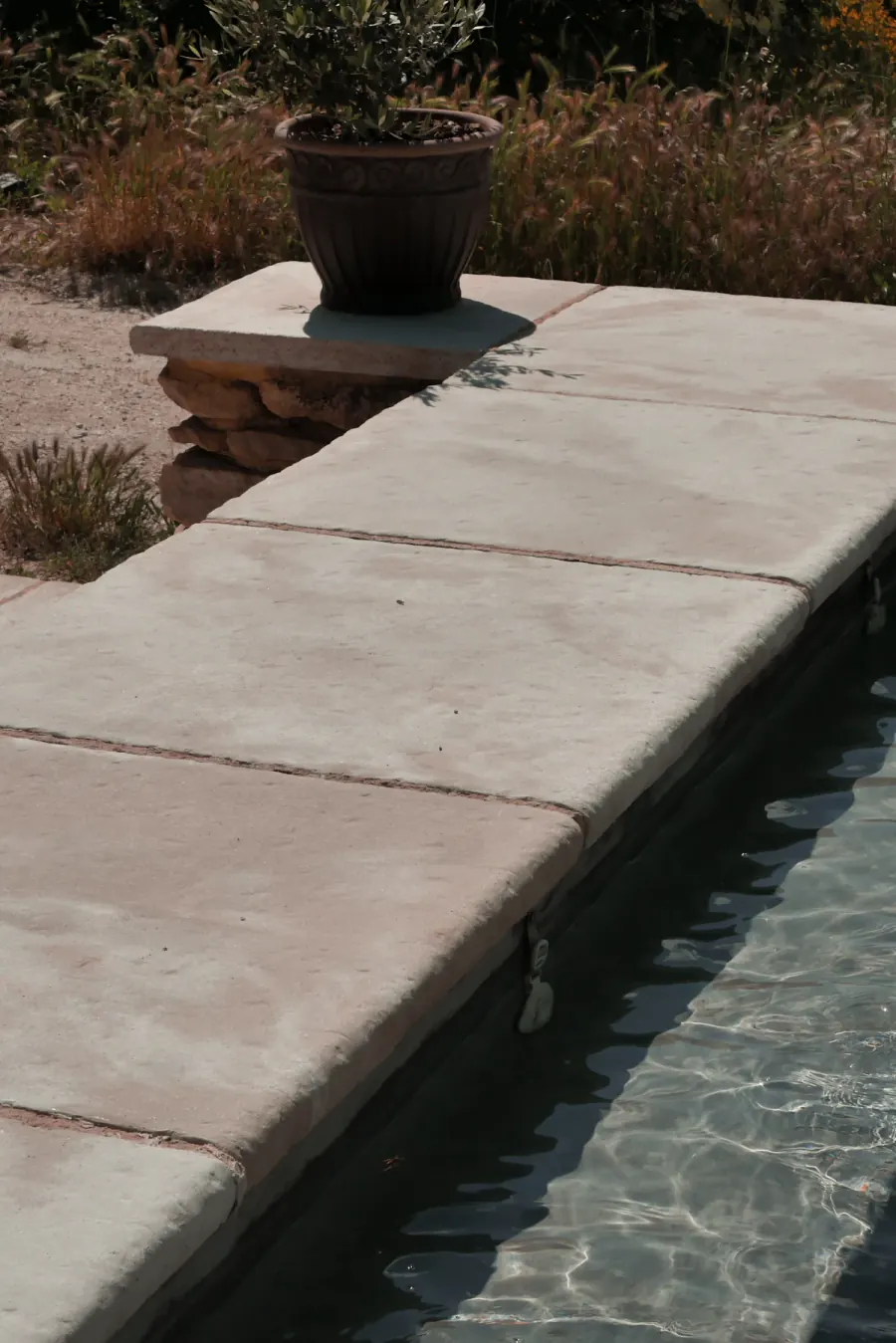
Patios and pool decks settle toward the house, which is the worst possible direction. A deck poured with a correct fall away from the structure can reverse with as little as an inch of settlement, and then every rain and every backwash sends water at your foundation instead of away from it.
Pool decks have an extra failure mode: the coping course sits over backfill around the pool shell, which is the least compacted soil on the property. Foam is the right method here, because a hundred-plus pounds per cubic foot of slurry on top of that backfill is asking for the next drop.
Two ways to lift a slab, and when each one is right
Both methods fill the void and raise the concrete. They differ in what they put under it, and on Lubbock's washed-out sandy subgrades that difference decides how long the lift holds.
Polyurethane foam injection
A two-part polymer injected through 5/8 inch ports that expands, fills the cavity and lifts. Cured foam weighs 2 to 4 lbs per cubic foot, sets in about 15 minutes, and does not wash out or shrink. Expected life 10 to 15 years, $5 to $12 per square foot. Default method here.
Mudjacking with cement slurry
A cement, sand and soil slurry pumped through 1 to 2 inch holes. Cheaper at $3 to $8 per square foot and genuinely useful on large, thick, well-supported commercial slabs. The slurry weighs 100 to 150 lbs per cubic foot, so it reloads a subgrade that already failed. Expected life 5 to 10 years.
Replacement, when lifting is dishonest
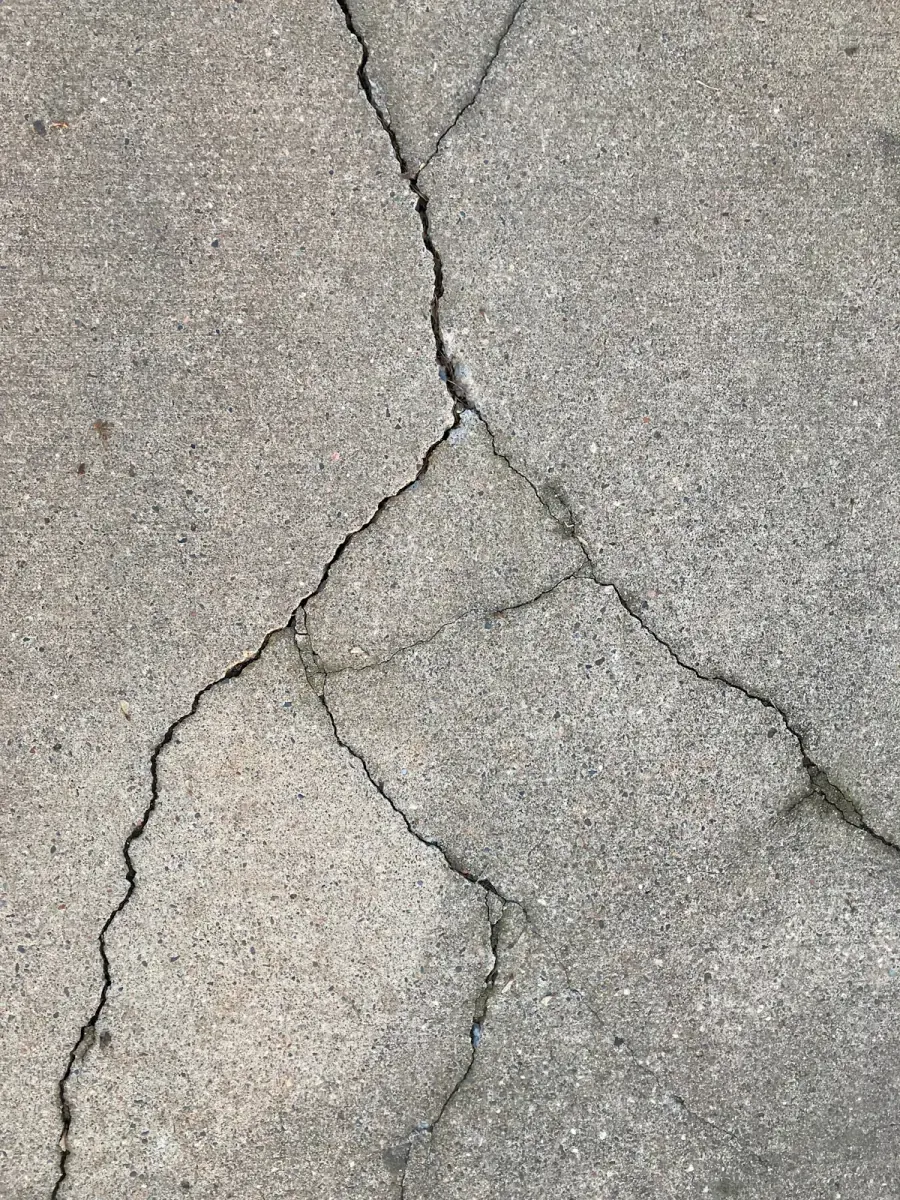
Some slabs should not be lifted. Concrete that has spalled through to the aggregate, shattered into many small fragments, or sits on a collapsing base cannot hold injection pressure. In those cases we say so in the written assessment and quote tear-out instead, rather than taking a deposit on a lift that will not hold.
A 400 square foot driveway panel lifted two inches with slurry takes on roughly 6,600 pounds of new material. The same lift with polyurethane foam adds around 200 pounds. On soil that already failed under the weight of the slab alone, that is not a detail, it is the reason one lift lasts a decade and the other does not.
The full head-to-head comparison, including hole size, cure time, cost and the cases where slurry genuinely wins, is on the mudjacking vs polyjacking page.
How a Lubbock lift actually runs
Six steps, one visit for most residential jobs. The stage that matters most is the one nobody photographs: filling the void before any lifting starts.
- 1
Free on-site assessment and elevation survey
We walk the slab, shoot elevations with a laser level, and find where the low point actually is rather than where it looks like it is. We check downspout discharge, approach grade and any playa or drainage channel the lot slopes toward, because a lift that ignores the water source is a lift that gets repeated.
- 2
Written scope with a port plan
You get a written scope listing the panels to be lifted, the target elevation, the number and spacing of injection ports, the method, and a fixed price. No verbal numbers, no per-hour surprises. If the assessment shows the slab is beyond lifting, the scope says so and quotes replacement instead.
- 3
Drill the injection ports
A rotary hammer drills 5/8 inch ports through the slab on a pattern matched to the panel size and the void shape underneath. Foam ports are deliberately small so the patches vanish into the surface. Mudjacking, when it is the right call, uses 1 to 2 inch holes instead.
- 4
Fill the void and stabilise the subgrade
The first injections do not lift anything. They fill the washed-out cavity under the slab and consolidate the loose sand around it, which is the step that determines whether the lift holds. On playa-margin lots with Randall clay we treat this stage as the real work and the lift as the visible byproduct.
- 5
Lift to grade under laser control
Once the void is full, pressure moves from the soil into the slab and it rises. We work port to port in small increments with a laser on the slab the whole time, stopping at the target elevation rather than at the highest number the rig can push. Slow and distributed is what keeps a sound slab from cracking.
- 6
Patch, clean and hand back
Ports get filled with a colour-matched compound, the work area gets swept and rinsed, and we walk the finished elevations with you. Foam-lifted slabs carry vehicle traffic immediately. You also get drainage notes, in writing, on anything we saw that will bring the slab back down if it is not addressed.
What it costs by surface
Prices below are real Lubbock-area ranges for lifting, not replacement. Every quote is written and fixed before work starts. If the assessment shows the slab should be replaced rather than lifted, you get that in writing too, with no charge for the visit.
| Surface | Typical size | Foam injection | Mudjacking |
|---|---|---|---|
| Single sidewalk panel | 25 sq ft | $500 to $700 | $500 to $600 |
| Front walk, 4 to 6 panels | 120 sq ft | $700 to $1,400 | $500 to $950 |
| Driveway approach only | 200 sq ft | $1,000 to $2,400 | $650 to $1,600 |
| Two-car driveway | 500 sq ft | $1,200 to $3,500 | $1,500 to $4,000 |
| Patio | 250 sq ft | $800 to $2,200 | $750 to $2,000 |
| Pool deck surround | 450 sq ft | $2,300 to $5,400 | Not recommended |
| Two-car garage floor | 400 sq ft | $2,000 to $4,800 | $1,200 to $3,200 |
| Warehouse bay | 2,000 sq ft | $10,000 to $24,000 | $6,000 to $16,000 |
Ranges assume a lift of 1 to 3 inches on an intact slab. Deeper drops need more material and more ports, and a slab with a large washed-out void under it costs more to fill than one sitting on a thin gap. Void filling with no lift is quoted separately.
The full Lubbock cost guide breaks each of these down by slab thickness, lift height, void volume and access, and shows the comparison against replacement pricing for the same surface.
Every surface we lift
Residential and commercial, indoors and out. If it is a concrete slab on grade and it has dropped, it is a candidate for lifting.
Driveway Leveling
Approaches, aprons and full drives lifted back to grade without tear-out.
Learn more →Sidewalk Leveling
Trip-hazard panels raised in under an hour, no permit required for a lift.
Learn more →Patio and Pool Deck
Restore the fall away from the house and the level of the coping course.
Learn more →Garage Floor Leveling
Lift a sunken or cracked garage slab with the vehicles and shelving still in place.
Learn more →Foundation Slab Leveling
Interior slab-on-grade lifting and void filling under living space.
Learn more →Commercial Leveling
Warehouse floors, dock approaches, parking areas and trip-hazard remediation.
Learn more →Mudjacking
The traditional slurry method, and the specific jobs where it still makes sense.
Learn more →Permits: lifting versus replacing in the City of Lubbock
Lifting your existing slab in place is a repair and generally does not pull a City of Lubbock permit. Replacing it does. Lubbock's ordinance is explicit that no person may begin to construct, reconstruct, repair, alter or replace sidewalks or driveways, or curbs and gutters on any public street or alley, without first obtaining a construction permit from the building official.
The contractor also has to be registered with the City. Registration requires proof of general liability insurance of at least $100,000, or a $20,000 compliance bond. Texas issues no state general contractor license for concrete work, so City registration plus a certificate of insurance is the real credential to ask any bidder for.
Worth knowing before you get quotes: new sidewalks and driveways in Lubbock must be a minimum of four inches thick, and residential sidewalk crossings have a maximum two percent slope. City of Lubbock Building Safety sits at 1314 Avenue K and the permit line is 806-775-3158.
Where we work
Lubbock and Lubbock County are the core. We also cover Hockley County to the west and Hale County to the north, which means Levelland and Plainview get the same crews and the same pricing as an in-town job.
Inside Lubbock we lift regularly in Tech Terrace, Maxey Park, LakeRidge and Vintage Township, and across the Lubbock ISD, Lubbock-Cooper ISD, Frenship ISD and Roosevelt ISD areas. The housing stock ranges from 1930s bungalows to 2007-and-newer builds, and the failure mode is different at each end of that range.
Read before you get quotes
Concrete Leveling Cost in Lubbock
Real per-square-foot ranges for foam and mudjacking, plus typical totals by driveway, patio, sidewalk and garage size.
Read it →Mudjacking vs Polyjacking
Slurry weight, hole size, cure time, service life and cost, compared head to head on Llano Estacado soils.
Read it →Concrete Lifting vs Replacement
When lifting the slab you already have is the right call, and the four conditions where tear-out is the only honest answer.
Read it →Signs Your Concrete Needs Leveling
Nine things to look for on a West Texas slab, and how to tell settlement from heave before you call anyone.
Read it →Concrete Permits in Lubbock
When City of Lubbock requires a permit, the four inch thickness minimum, and what contractor registration means in a state with no concrete licence.
Read it →Concrete leveling in Lubbock: common questions
How much does concrete leveling cost in Lubbock?
Concrete leveling in Lubbock runs $3 to $8 per square foot for mudjacking and $5 to $12 per square foot for polyurethane foam injection, with small single-panel lifts starting around $500. A typical two-car driveway lands between $1,200 and $3,500 and a settled patio between $800 and $2,200. The spread comes down to how far the slab has dropped, how much void has opened underneath, and how many injection ports the lift needs.
Is it cheaper to level concrete or replace it?
Lifting is cheaper, usually by 40 to 70 percent. Replacing a two-car driveway in Lubbock means demolition, haul-off, new base, new forms, new concrete and a week of cure time, which routinely runs three to four times the cost of lifting the slab you already own. Replacement only wins when the concrete itself has failed: spalled through, shattered into more pieces than it has panels, or poured so thin it cannot take injection pressure.
Why is my driveway sinking in Lubbock?
Most Lubbock driveways sink because water washed the fine sand out from under them, not because the concrete failed. The Southern High Plains sits on loamy eolian deposits of the Blackwater Draw Formation over a calcic caliche horizon 30 to 60 inches down. Water that cannot pass the caliche runs sideways, and with 19 inches of annual rain arriving in a handful of intense storms, downspouts and driveway approaches concentrate enough flow to carve a void. The slab spans the void until a vehicle loads it, then it drops.
How long does concrete leveling take?
Most residential lifts are finished in two to five hours, start to finish, in a single visit. Polyurethane foam reaches roughly 90 percent of its strength in about 15 minutes, so the ports get patched and the slab takes vehicle traffic the same day. Mudjacking needs the slurry to set, which typically means staying off the slab for 24 to 72 hours depending on temperature.
How soon can you drive on leveled concrete?
You can drive on a foam-lifted slab the same day, usually within the hour. The two-part polyurethane cures by chemical reaction rather than by drying, so ambient temperature barely matters and there is no water to evaporate. Mudjacked slabs need 24 to 72 hours before vehicle loading because the cement slurry has to hydrate and gain strength.
How big are the holes for concrete leveling?
Polyurethane foam injection uses 5/8 inch ports. Mudjacking uses 1 to 2 inch holes because the slurry is far thicker and needs volume to move. Both get patched with a colour-matched compound, but 5/8 inch patches disappear into the surface texture in a way that 2 inch patches never quite do, which matters on a stamped patio or a visible front walk.
Does concrete leveling crack the slab?
A correctly executed lift does not crack a sound slab, because the lift is distributed across many ports rather than forced through one. Cracking happens when a single port is over-pressured, when the port pattern is too sparse for the panel size, or when the slab was already fractured and the lift simply revealed it. Existing cracks will stay visible after the lift, they will not close up, and any honest quote says so before the work starts.
How long will leveled concrete last?
Polyurethane foam lifts typically hold 10 to 15 years, mudjacked lifts 5 to 10 years. The difference is weight. Cured foam weighs 2 to 4 pounds per cubic foot, while a cement and soil slurry weighs 100 to 150 pounds per cubic foot. Mudjacking adds thousands of pounds of new load onto the same subgrade that failed in the first place, which is why the second settlement usually arrives sooner.
Do you need a permit to level concrete in Texas?
Lifting an existing slab in place is a repair and generally does not require a City of Lubbock permit. Replacing a driveway approach, a public sidewalk, or curb and gutter does require a construction permit from the building official, and the contractor has to be registered with the City. Registration requires either $100,000 of general liability coverage or a $20,000 compliance bond. City of Lubbock Building Safety is at 1314 Avenue K and can be reached at 806-775-2087.
Do concrete contractors need a license in Texas?
No. Texas issues no state general contractor license, no statewide exam and no statewide bond for concrete work. Only electricians, plumbers and HVAC technicians carry state credentials. What matters locally is City of Lubbock contractor registration plus proof of insurance, which is exactly what you should ask any bidder to produce before work starts.
Can concrete be leveled in winter?
Yes. Polyurethane foam cures through a chemical reaction rather than by drying, so it works through Lubbock's Oct to Apr freeze window and through January lows around 26 degrees. Mudjacking is the method that struggles in cold, because the slurry has to hydrate and can freeze before it gains strength. Winter is also the honest time to lift, because a subgrade that is dry and contracted gives a truer picture of the low point than one that is swollen after a summer storm.
What is the difference between settling and heaving?
Settlement drops a slab, heave pushes it up. In Lubbock you get both, and the soil under the slab tells you which. On the Amarillo, Acuff and Olton uplands the failure is almost always settlement from washed-out sand over the caliche. On playa rims, where Randall clay sits, the smectitic clay swells when ponded and shrinks when dry, so the same corner can rise one season and fall the next. Lifting a heaving slab without addressing drainage just buys a short reprieve.
Does Texas homeowners insurance cover concrete leveling?
Usually not. Standard Texas homeowners policies exclude earth movement, settling and soil expansion, which covers the overwhelming majority of concrete leveling work. The narrow exception is settlement caused by a covered sudden event, such as a plumbing leak under the slab, where some policies will pay for repair of the resulting damage. Read the earth movement exclusion in your own policy before assuming either way.
Can a cracked slab be lifted?
Yes, as long as the panels are still structurally intact. A slab with one or two clean cracks lifts fine, and the port pattern is simply adjusted so each fragment gets its own support. A slab that has broken into many small pieces, spalled through to the aggregate, or sits on a failing base cannot hold injection pressure, and replacement is the honest answer. A free on-site assessment sorts one case from the other in about 20 minutes.
What areas around Lubbock do you serve?
We cover Lubbock and Lubbock County, plus Wolfforth, Shallowater, Idalou and Slaton, and reach west to Levelland in Hockley County and north to Plainview in Hale County. Lubbock neighborhoods including Tech Terrace, Maxey Park, LakeRidge and Vintage Township are all inside the core service area, and quotes are free anywhere in that footprint.
Get a free written quote on your slab
Tell us which slab has dropped and roughly how far. We come out, shoot elevations, and come back with a fixed price and a port plan in writing. If lifting is the wrong answer for your slab, we tell you that instead.
- Free written scope with a measured lift plan, not a verbal number
- Polyurethane foam on 5/8 inch holes, patched and colour matched
- Drive on the slab the same day, usually within the hour
- Insured crews, written workmanship guarantee on every lift