
Patio and Pool Deck Leveling in Lubbock, TX
A settled patio stops draining away from your house and starts draining at it. We lift patios and pool decks back to their original fall from $800, without touching the stamp, the stain or the sealer.
Patio and pool deck leveling raises a settled slab back to its original drainage fall, and in Lubbock it costs $800 to $2,200 for a typical 250 square foot patio or $2,300 to $5,400 for a 450 square foot pool deck surround. The work is done through 5/8 inch injection ports, so a stamped, stained or sealed finish survives untouched. You use the space again the same day.
The reason to act is not cosmetic. A patio poured with a proper fall away from the house needs only about an inch of settlement at its outer edge to reverse that slope. Once it reverses, every storm and every pool backwash sends water toward your foundation. Lubbock's rainfall pattern makes that worse than the annual total suggests: 19 inches a year delivered in a handful of intense convective storms means large volumes arriving fast, with nowhere to go but where the concrete points it.
Why patios and pool decks settle first
Patios and pool decks settle before other flatwork because they sit on backfill rather than undisturbed ground. A patio is typically poured against the house over the trench excavated for the foundation. A pool deck sits over the ring of fill packed around the shell after installation. In both cases the soil underneath was put there by a machine in a hurry, not laid down over millennia, and it continues to consolidate for years.
Lubbock's soils make that fill especially mobile. The upland series here, Amarillo fine sandy loam and Acuff loam, are well drained and moderately permeable, sitting over a calcic caliche horizon 30 to 60 inches down. Water moves down through sand easily, hits the cemented layer, and runs sideways. Where a downspout discharges at a patio edge, or where irrigation runs along a deck, that lateral flow carries the fines out of the backfill and the slab follows.
Pool decks have a second failure mode
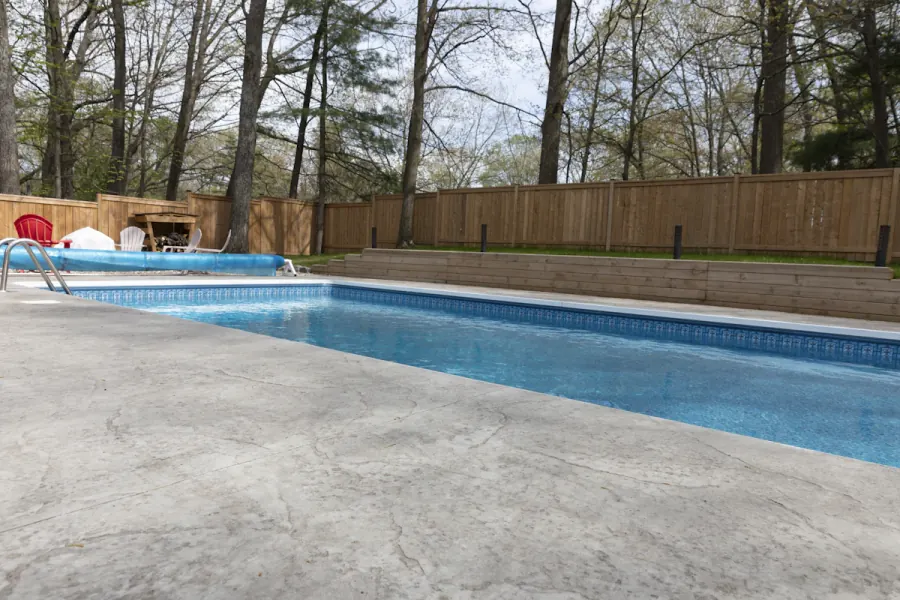
The coping course sits directly over the backfill ring around the pool shell, which is the least compacted soil anywhere on the property. When that ring consolidates, the deck drops in a predictable pattern: worst immediately at the coping, tapering out toward the field of the deck.
That is exactly why weight matters here. Cured polyurethane foam weighs 2 to 4 pounds per cubic foot. A cement and soil mudjacking slurry weighs 100 to 150 pounds per cubic foot. Pumping thousands of pounds of slurry onto backfill that could not hold the deck alone is a short-term fix with a predictable ending, which is why we do not quote mudjacking on pool decks.
Foam is also closed cell and does not absorb water, which is a genuine consideration six inches from a pool and under a surface that gets splashed and hosed daily.
How we level a patio or pool deck
Three to five hours on a typical residential slab. The pool stays full and the furniture goes back the same afternoon.
- 1
Check the fall, not just the level
A patio is supposed to be sloped, so a laser reading of flat is a failure, not a pass. We measure the fall away from the house across the whole slab and record where it has reversed, which is the number that actually matters on a patio or a pool deck.
- 2
Assess the slab thickness and finish
Decorative patios are often thinner than structural flatwork, and overlays sit on top of an older slab. Both change the port spacing and the injection pressure we can use. We identify the build-up before drilling so the lift is planned around what is actually there.
- 3
Map ports into the pattern
On stamped or stained concrete, ports go into joint lines and the low points of the stamp where they disappear. On a pool deck they are kept off the coping course where possible and worked from the field of the deck inward, because the coping is the least forgiving element on the job.
- 4
Fill the backfill void
Patio and pool deck voids are usually larger than driveway voids because the fill was deep and poorly compacted. The first stage consolidates that fill and fills the cavity. On a pool surround this is the stage that determines whether the ring settles again in three years.
- 5
Lift to restore the slope
We raise the inner edge or the outer edge depending on which way the fall has gone wrong, working in small increments with a laser on the slab. The target is the original drainage fall away from the structure, not a flat surface.
- 6
Patch, rinse and reopen
Ports are filled with colour-matched compound and the slab is rinsed down. Furniture goes back the same day and the pool stays in service throughout. We hand over written notes on gutter discharge and irrigation that will refill the void if left alone.
Patio and pool deck leveling cost in Lubbock
Lifting runs $5 to $12 per square foot with polyurethane foam on patios and decks. The per-foot number sits toward the top of that range on pool surrounds and decorative slabs, because tighter port spacing and lower injection pressure mean more ports and more time for the same area.
| Slab | Size | Lift with foam | Replace |
|---|---|---|---|
| Small patio | 120 sq ft | $600 to $1,300 | $1,600 to $3,000 |
| Standard patio | 250 sq ft | $800 to $2,200 | $3,000 to $6,000 |
| Large entertaining patio | 500 sq ft | $2,000 to $4,800 | $6,000 to $11,000 |
| Pool deck surround | 450 sq ft | $2,300 to $5,400 | $9,000 to $18,000 |
| Coping course only | 90 linear ft | $1,100 to $2,600 | $4,000 to $7,500 |
| Stamped or stained slab | 250 sq ft | $1,100 to $2,600 | $4,500 to $9,000 |
Replacement figures for stamped and stained concrete carry a premium because pattern and colour matching to the rest of the property is rarely straightforward, and older stamp mats are often discontinued.
A stamped, stained or sealed slab has value in its surface that a plain grey slab does not. Lifting preserves all of it because nothing is touched but 5/8 inch ports. Replacing means sourcing a matching stamp mat, matching an aged colour, and accepting that the new section will read differently from the rest of the property for years. On decorative work the cost gap and the outcome gap both point the same way.
The drainage question you should ask first
Before lifting anything, find out where the water comes from. Stand at the low corner during the next storm and watch. On most Lubbock lots the answer is one of three things: a downspout discharging within a few feet of the slab edge, a yard grade that has flattened or reversed over the years, or an irrigation line running parallel to the deck.
On lots that drain toward a playa basin, add a fourth. Lubbock has a large number of playas, many incorporated into city parks and used for municipal stormwater detention, and lots near their rims sit on Randall clay: a very-fine, smectitic, poorly drained soil that ponds for long periods and swells and shrinks dramatically. The Texas Water Development Board measures playa infiltration at 0.04 to over 0.8 inches per day, which is another way of saying water sits there. A patio on that ground moves seasonally, and a lift needs to be planned around that rather than in spite of it.
What we tell you if lifting is the wrong answer
A patio that has broken into many small pieces, an overlay that has delaminated from the slab beneath, or a deck whose bond beam has cracked at the pool shell are all cases where lifting will not deliver what you want. We put that in the written assessment rather than discovering it after a deposit. The full decision framework is on the lifting versus replacement page.
Patio and pool deck leveling questions
What is the average cost to level a concrete patio?
Leveling a concrete patio in Lubbock costs $800 to $2,200 for a typical 250 square foot slab, which works out to roughly $5 to $12 per square foot with polyurethane foam. A pool deck surround of 450 square feet runs $2,300 to $5,400 because the coping course needs careful, low-pressure work. Replacement of the same patio would be $3,000 to $6,000 and take a week.
What causes a patio to sink?
Patios sink because the soil under them was backfill, not undisturbed ground, and water washed it out. A patio is usually poured against the house over the trench that was excavated for the foundation, and that fill is the least compacted soil on the property. Add Lubbock's pattern of 19 annual inches arriving in a few intense storms, plus roof runoff discharging right at the patio edge, and the fines migrate away within a few seasons.
Can a concrete pool deck be lifted instead of replaced?
Yes, and lifting is usually the right call because pool decks sit on the worst soil on the property. The backfill packed around a pool shell after installation settles for years, so the deck above it drops in a predictable ring. Polyurethane foam lifts that deck without adding meaningful weight to the same backfill, which a cement slurry would. Foam is also closed cell and does not absorb water, which matters six inches from a pool.
Why does my patio now drain toward the house?
Because it settled. A patio poured with a correct fall away from the structure needs only about an inch of settlement at the outer edge to reverse its slope, and then every rain and every pool backwash runs at your foundation instead of away from it. This is the single most damaging consequence of a settled patio and the main reason it is worth fixing before it looks dramatic.
Will lifting damage my stamped or stained concrete?
No, and that is the main argument for lifting a decorative slab. The surface is never touched apart from 5/8 inch injection ports, so the stamp pattern, the colour and the sealer all stay exactly as they are. Ports are placed in joint lines and low points of the pattern where possible and patched with a colour-matched compound. Replacing a stamped patio means matching a pattern and colour that may no longer be available.
How long before I can use the patio after leveling?
The same day, usually within the hour. Polyurethane foam reaches roughly 90 percent of its strength about 15 minutes after injection, so furniture goes back and the pool is usable as soon as the ports are patched and the area is rinsed. Mudjacking the same patio would need 24 to 72 hours of staying off it while the slurry gains strength.
Can you lift a pool deck without draining the pool?
Yes. Nothing about foam injection requires the water level to change, and the work happens entirely from the deck surface. What we do check first is the bond beam and coping condition, because a deck that has dropped enough to crack the coping or open the tile line needs that addressed as part of the scope rather than after.
Does concrete leveling crack a patio slab?
A correctly executed lift does not crack a sound patio, because the lift is spread across many ports at low pressure rather than forced through a few. Thin decorative slabs need more ports at tighter spacing than a driveway does, since a two-inch overlay slab has far less stiffness than a four-inch structural pour. Existing cracks stay visible after the lift and will not close up.
Is a settled patio a foundation problem?
The patio itself is not, but the water that sank it often is. Patios sit on foundation backfill, so a settling patio is direct evidence that water is moving through the soil alongside your foundation and carrying material with it. If the patio has reversed its slope toward the house, the situation is actively getting worse, and it is worth checking interior slab elevations on the same visit.
Get a quote on your patio or pool deck
Tell us which way the slab now drains and roughly how far it has dropped. We measure the fall across the whole slab and come back with a fixed price and a port plan that respects your finish.
- Free written scope with a measured lift plan, not a verbal number
- Polyurethane foam on 5/8 inch holes, patched and colour matched
- Drive on the slab the same day, usually within the hour
- Insured crews, written workmanship guarantee on every lift