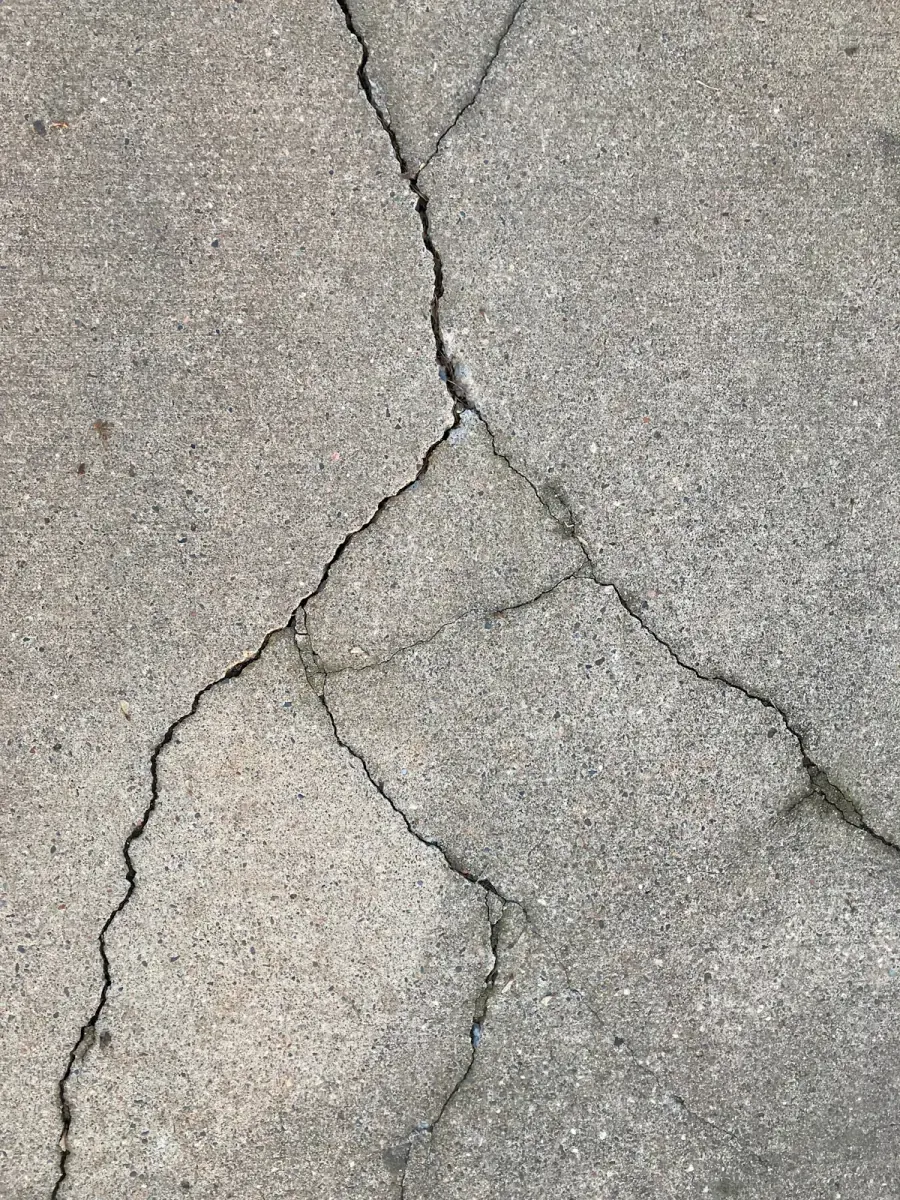
Polyurethane Foam Injection in Lubbock, TX
Foam lifting costs $5 to $12 per square foot, uses 5/8 inch ports, cures in about 15 minutes and adds 2 to 4 pounds per cubic foot instead of 100 to 150. On soil that already failed once, that last number is why it is our default method.
Polyurethane foam injection lifts a settled concrete slab by injecting a two-component polymer through 5/8 inch ports, and in Lubbock it costs $5 to $12 per square foot. The foam expands into the void under the slab, densifies the loose soil around it, and then raises the concrete. It reaches roughly 90 percent strength in about 15 minutes, so the slab carries full load the same day.
The method is sometimes called polyjacking or polylevelling. Mechanically it does two jobs that older methods do not separate well: it fills a cavity, and it compacts the weak soil around that cavity. On Lubbock's washed-out sandy subgrades the second job is the one that determines how long the repair lasts.
Why weight is the deciding factor here
Cured polyurethane lifting foam weighs 2 to 4 pounds per cubic foot. A cement, sand and soil mudjacking slurry weighs 100 to 150 pounds per cubic foot. Those numbers are not a marketing comparison, they are the physical reason the two methods age differently.
Take a 400 square foot driveway that has dropped two inches. Filling that void and lifting the slab takes roughly 67 cubic feet of material. With foam that is about 200 pounds of new load on the subgrade. With slurry it is around 6,600 pounds. The soil under that driveway already proved it could not reliably carry the concrete alone. Adding three tons to it is a decision with a predictable ending, which is why foam lifts typically hold 10 to 15 years while mudjacked lifts average 5 to 10.
What the foam does to Lubbock soil
Expanding foam does not only fill space, it applies pressure outward into whatever surrounds it. In a washed-out cavity under a Lubbock driveway, that surrounding material is loose sand left behind after the fines migrated away. The foam compresses it, which increases its density and its bearing capacity.
That matters because of what the soil here is. The uplands are Amarillo fine sandy loam and Acuff loam, formed in loamy eolian deposits of the Blackwater Draw Formation, well drained and moderately permeable over a calcic caliche horizon 30 to 60 inches down. Water moves through that profile easily, hits the cemented layer, and runs sideways carrying fines. What is left is a skeleton of coarse sand with voids between grains, and that is exactly the material foam consolidates well.
On playa margins, where the soil is Randall clay, a very-fine smectitic clay that ponds for long periods and swells and shrinks, the calculation changes. Foam still fills and lifts, but it cannot stop a clay from swelling. Those lots need the drainage addressed as part of the scope, and we say so in writing rather than after.
How a foam injection lift is executed
Two to five hours on typical residential flatwork. Roughly two thirds of the material goes into the soil before the slab moves at all.
- 1
Survey and mark the port grid
Laser elevations across the slab establish the low points and the target. Ports are then marked on a grid sized to the panel and the void, typically every three to five feet on flatwork and tighter on thin or decorative slabs, because distributing the lift is what protects the concrete.
- 2
Drill 5/8 inch ports
A rotary hammer with a masonry bit drills clean 5/8 inch ports through the slab. On stamped or stained surfaces the ports are placed into joint lines and pattern low points so the patches vanish. Dust is controlled at the bit rather than cleaned up afterward.
- 3
Set injection ports and connect the rig
Ports are fitted and the two-component rig is connected. The resin and isocyanate are heated and metered separately, mixing only at the gun tip, which is what gives a consistent reaction and predictable expansion rather than a variable one.
- 4
Fill the void and densify the soil
The opening injections do no lifting. Foam expands into the cavity, then continues into the loose sand around it, compressing and densifying it. On a washed-out Lubbock subgrade this stage consumes most of the material and determines whether the repair lasts a decade or a season.
- 5
Lift in increments, port to port
Once the soil can take no more, pressure transfers into the slab and it rises. We move between ports in small increments with the laser reading continuously, watching the slab rather than the gauge, and stop at the target elevation instead of at the last inch the rig could push.
- 6
Patch and return to service
Ports are filled with a colour-matched compound flush to the surface, the area is swept and rinsed, and the slab takes full load immediately. Finished elevations are re-shot and walked with you before we leave.
Foam injection cost in Lubbock
Foam lifting is priced at $5 to $12 per square foot in Lubbock, with the national range reaching $25 per square foot on deep lifts and specialised applications. The reason for the spread inside a single market is void volume: two driveways of identical area can need very different amounts of material depending on how large a cavity has opened beneath them.
| Slab | Size | Typical cost | Time on site |
|---|---|---|---|
| Sidewalk panel | 25 sq ft | $500 to $700 | Under 1 hour |
| Front walk | 120 sq ft | $700 to $1,400 | 1 to 2 hours |
| Driveway approach | 200 sq ft | $1,000 to $2,400 | 2 to 3 hours |
| Two-car driveway | 500 sq ft | $1,200 to $3,500 | 3 to 5 hours |
| Patio | 250 sq ft | $800 to $2,200 | 2 to 4 hours |
| Two-car garage floor | 400 sq ft | $2,000 to $4,800 | 4 to 6 hours |
| Pool deck surround | 450 sq ft | $2,300 to $5,400 | 4 to 6 hours |
A deep lift or a large washed-out cavity increases material volume and therefore cost, independent of slab area. Quotes state a fixed price for the assessed void and a per-unit rate for material beyond it, so there are no open-ended numbers.
On a thick, well-supported industrial slab over engineered fill, the weight argument largely disappears and mudjacking is genuinely competitive at $3 to $8 per square foot. And no injection method, foam included, rescues a slab that has spalled through to the aggregate, broken into many small fragments, or was poured under four inches with no base. Those are replacement jobs and we say so in the written assessment.
Foam against mudjacking, in numbers
The two methods do the same job and differ on five measurable points. Cost: $5 to $12 per square foot for foam against $3 to $8 for slurry. Hole size: 5/8 inch against 1 to 2 inch. Weight added: 2 to 4 pounds per cubic foot against 100 to 150. Cure before load: about 15 minutes against 24 to 72 hours. Expected service life: 10 to 15 years against 5 to 10.
Mudjacking wins on upfront price, and on a large thick slab over sound subgrade that can be the right trade. Foam wins on everything else, and on the residential washed-out subgrades that make up most Lubbock work, the weight and service-life numbers are decisive. The full head-to-head, including the specific cases where slurry is the better call, is on the mudjacking vs polyjacking page.
What foam is made of, practically
Structural lifting foam is a two-component system: a polyol resin and an isocyanate, heated and metered separately and mixed only at the gun tip. The reaction is exothermic and fast, which is why cure time is measured in minutes and why cold weather does not stop it. Once fully reacted the material is a rigid closed-cell solid: hydro-insensitive, chemically stable, not a food source for insects or rodents, and dimensionally stable under normal slab loading. That stability is why it is used under pool decks, inside occupied houses, and beneath warehouse floors carrying forklift traffic.
What we do not promise
Foam does not close cracks, it corrects elevation. It does not stop a tree root growing under a sidewalk. It does not stop smectitic clay on a playa margin from swelling when the basin ponds. And it does not fix a drainage problem: if a downspout is discharging onto the approach, the void starts re-forming the day we leave regardless of what is under the slab. Every written scope we issue names the water source we observed, whether or not the fix is in our scope.
Polyurethane foam injection questions
How much does it cost to lift concrete with polyurethane foam?
Polyurethane foam concrete lifting costs $5 to $12 per square foot in typical Texas residential work, with the national range stretching to $25 per square foot on specialised or deep-lift jobs. In Lubbock that means roughly $500 to $700 for a single sidewalk panel, $1,200 to $3,500 for a two-car driveway, and $2,000 to $4,800 for a two-car garage floor. Price is driven by void volume, not just slab area.
How long does polyurethane foam last under concrete?
Cured polyurethane lifting foam does not degrade, and lifts typically hold 10 to 15 years. The foam itself is inert, closed cell, hydro-insensitive and not a food source for pests, so it does not wash out, dissolve, rot or compress under normal slab loading. What ends a repair is the soil around the foam continuing to move, which is why an uncorrected drainage problem, not the material, is the usual reason a slab settles again.
What are the disadvantages of polyurethane foam injection?
Three real ones. It costs more per square foot than mudjacking, roughly $5 to $12 against $3 to $8. It requires specialised equipment and trained operators, so it is not a method a general handyman can offer. And it cannot fix a slab that has structurally failed: foam lifts sound concrete, and no injection method saves a slab that has spalled through or broken into many fragments. It is also not the cheapest answer on thick, well-supported industrial slabs where added weight is not a concern.
How big are the holes for foam injection?
Polyurethane foam injection uses 5/8 inch ports, compared with 1 to 2 inch holes for mudjacking. The difference is practical, not cosmetic trivia: a 5/8 inch patch disappears into a broomed or stamped surface from standing height, while a 2 inch patch is a visible grey dot for the life of the slab. On decorative patios and front walks, hole size is often the deciding factor.
How soon can you drive on foam-lifted concrete?
Same day, usually within the hour. Two-part polyurethane reaches roughly 90 percent of its compressive strength about 15 minutes after injection. It cures by chemical reaction rather than by drying, so nothing has to evaporate and ambient temperature barely affects the schedule. That is the main reason foam works through Lubbock's winter while mudjacking struggles.
How much does the foam weigh?
Cured structural lifting foam weighs 2 to 4 pounds per cubic foot. A cement, sand and soil mudjacking slurry weighs 100 to 150 pounds per cubic foot. On a 400 square foot driveway lifted two inches, that is roughly 200 pounds of new material with foam against about 6,600 pounds with slurry. On subgrade that already failed under the slab alone, that difference is the whole argument.
Does foam injection work in cold weather?
Yes. The reaction that cures polyurethane is chemical and largely self-heating, so it proceeds through Lubbock's freeze window from October to April and through January lows around 26 degrees. Mudjacking is the method that suffers in cold, because a cement slurry has to hydrate and can freeze before it gains strength. Winter is also a good time to measure, since a dry contracted subgrade shows the true low point.
Is polyurethane foam safe around my home and pool?
Cured structural lifting foam is inert and closed cell. It does not absorb water, leach, support mould growth, or provide a food source for insects or rodents, which is why it is used under pool decks and inside occupied houses. The reactive components are handled by trained operators during injection and are fully reacted within minutes, at which point the material is chemically stable.
Can foam lift a slab that has cracks in it?
Yes, provided the fragments are still large and structurally intact. The port pattern is adjusted so each fragment is supported independently, and injection pressure is kept low and distributed. What foam cannot do is close the cracks. The elevation is corrected and the crack stays visible, so if appearance matters the crack needs separate cosmetic repair after the lift.
Get a foam injection quote
Tell us which slab has dropped and how far. We shoot elevations, estimate the void, and give you a fixed price with the port plan and the material volume stated up front.
- Free written scope with a measured lift plan, not a verbal number
- Polyurethane foam on 5/8 inch holes, patched and colour matched
- Drive on the slab the same day, usually within the hour
- Insured crews, written workmanship guarantee on every lift