Driveway Leveling in Lubbock, TX
Lifting a settled two-car driveway in Lubbock costs $1,200 to $3,500 with polyurethane foam, against $6,000 and up to tear it out and repour. Most drives are finished in a single visit and you park on them the same day.
Driveway leveling raises a sunken drive back to its original elevation by filling the void beneath it, and in Lubbock it costs $1,200 to $3,500 for a typical two-car driveway. Lifting just the settled approach, which is the most common job, runs $1,000 to $2,400. Nothing gets demolished, the concrete you already have stays, and with foam injection you drive on it within the hour.
That matters because the driveway in front of you is probably fine. Walk down almost any street in Tech Terrace, LakeRidge or Vintage Township and look at the dropped aprons: the concrete is whole, the surface is intact, and the panel has simply moved down an inch or two relative to the street. The concrete did not fail. The soil under it left.
Why Lubbock driveways sink at the approach first
The approach drops first because it takes the most water and had the most disturbed base. Lubbock sits on the Llano Estacado at 3,202 feet, on loamy eolian deposits of the Blackwater Draw Formation. The dominant upland soils, Amarillo fine sandy loam and Acuff loam, are well drained and moderately permeable, with a calcic horizon, the caliche caprock, sitting 30 to 60 inches down.
Lubbock averages 19 inches of rain a year but receives it in a handful of intense storms. Water soaks through the sandy upper profile, reaches the cemented caliche, and cannot go further down, so it travels laterally. Anywhere that flow concentrates, and a driveway approach concentrates it by design, the moving water carries the fine sand fraction with it. Over a few seasons that produces a cavity. The slab spans it fine until a vehicle rolls over, and then it drops.
On flatter lots with Olton clay loam, 35 to 50 percent clay with moderately slow permeability, the mechanism is different: water perches under the slab instead of draining through, saturating and softening the bearing layer until the driveway punches down into it. Either way the concrete is intact and the fix is under it, not in it.
The three places a drive drops
At the street. The approach panel sits over the most recently disturbed soil on the property and carries every drop of runoff leaving the drive. A lip here is the classic Lubbock job and the cheapest one to fix, because the void is usually shallow and localised.
At the garage apron. The apron meets the garage slab, which is supported differently, so any settlement shows up as a step. This one gets worse fast because the step traps water against the garage.
Along one edge. A drive that has tilted rather than dropped is usually reading the yard grade. If the low edge is the side the downspouts discharge to, the cause is not mysterious. Lifting the edge without redirecting the water buys a couple of years at most.
How we lift a Lubbock driveway
Three to five hours on a typical two-car drive, in one visit, with the elevations measured rather than eyeballed.
- 1
Shoot the driveway elevations
We run a laser across the full drive, the approach and the garage apron and record where each panel actually sits relative to the street and the slab-on-grade. This is what separates a real lift plan from a guess, because the visibly worst panel is often not the lowest one.
- 2
Trace the water
We find where the washout came from: downspout discharge, a reverse yard grade, an approach that dams runoff, or a lot that drains toward a playa margin. That determines whether foam alone will hold or whether drainage has to change first. It goes in the written scope either way.
- 3
Set the port pattern
Ports are laid out on a grid matched to panel size and the shape of the void beneath, typically every three to five feet, and drilled at 5/8 inch through the slab. More ports at smaller spacing means the lift is distributed, which is what keeps a sound driveway from cracking under pressure.
- 4
Fill the void first
The opening injections fill the cavity and consolidate the loose sand around it. Nothing rises yet, and that is correct. On a badly washed-out approach this stage can take the majority of the material, and skipping it is the reason a cheap lift drops again within a season.
- 5
Lift to grade
Once the void is full, pressure transfers into the slab and it rises. We work port to port in small increments with the laser on the slab throughout, matching the approach to the street lip and the apron to the garage slab, then stop at target rather than pushing further.
- 6
Patch and hand back
Ports are filled with a colour-matched compound, the drive is swept and rinsed, and we walk the finished elevations with you. Park on it immediately. You also get written notes on any drainage issue that will bring the slab back down if it is left alone.
What driveway leveling costs in Lubbock
Lifting a driveway in Lubbock costs $3 to $8 per square foot with mudjacking and $5 to $12 per square foot with polyurethane foam. Foam costs more per foot and is still the better value on most residential drives, because it adds almost no weight to soil that already gave way once.
| Job | Size | Foam injection | Replacement |
|---|---|---|---|
| Approach panel only | 100 sq ft | $600 to $1,200 | $1,500 to $2,600 |
| Approach plus first panel | 200 sq ft | $1,000 to $2,400 | $2,800 to $4,800 |
| Single-car drive | 300 sq ft | $900 to $2,400 | $3,600 to $6,000 |
| Two-car drive | 500 sq ft | $1,200 to $3,500 | $6,000 to $10,000 |
| Long rural drive | 1,200 sq ft | $4,500 to $11,000 | $14,000 to $24,000 |
Replacement figures assume demolition, haul-off, four-inch minimum thickness per City of Lubbock requirements, new base and new concrete. They exclude permit fees, which apply to approach and public sidewalk work.
The cost of a lift tracks the size of the void, not the size of the slab. A half-inch drop caught this year is a small cavity and a small material bill. The same driveway at two inches has a cavity several times the volume, needs more ports, and often needs the subgrade consolidated before anything will rise. Waiting does not save money on this one.
Full breakdown by lift height, void volume and slab thickness is in the Lubbock concrete leveling cost guide.
When we tell you to replace instead
Four conditions make lifting the wrong answer, and we put them in the written assessment rather than discovering them after taking a deposit.
The slab is under four inches. City of Lubbock requires a four-inch minimum on new driveways for a reason. Thinner concrete, common on pre-code pours, cannot take injection pressure without fracturing.
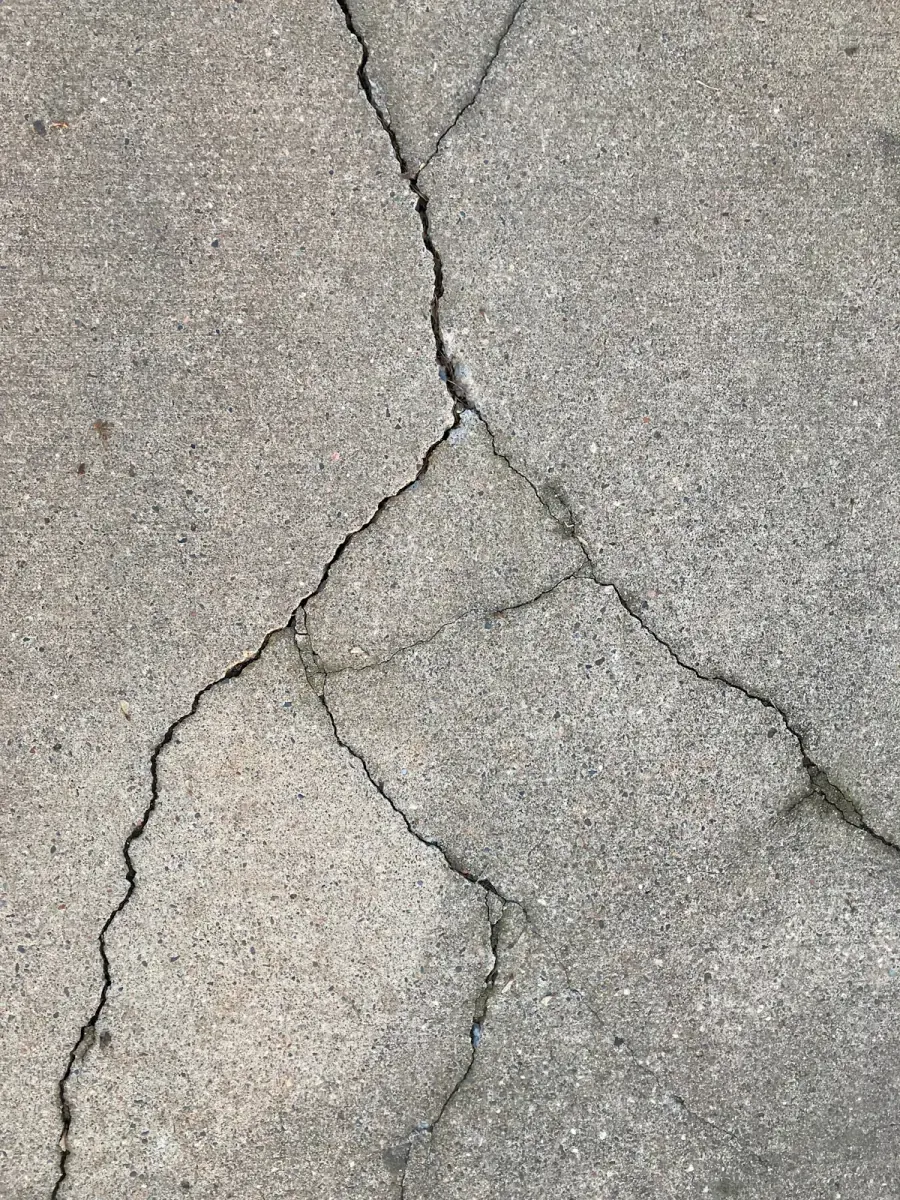
It has broken into many pieces. A drive with a dozen fragments per panel has no structural continuity left. Lifting moves the pieces independently and the result looks worse than the problem.
The surface has spalled through. If freeze cycles have popped the top layer off and exposed aggregate across the drive, the concrete is at the end of its service life regardless of elevation.
There is no base left at all. Occasionally a drive sits over a cavity so large, usually along a failed storm line, that filling it is a geotechnical job rather than a lift. We say so and refer it out.
Permits, and why lifting avoids one
Lifting your existing driveway in place is a repair and generally does not require a City of Lubbock permit, while replacing the approach does. The City ordinance is explicit: no person may begin to construct, reconstruct, repair, alter or replace sidewalks or driveways on any public street or alley without first obtaining a construction permit from the building official.
Whoever does that replacement also has to be registered with the City of Lubbock, which requires proof of general liability insurance of at least $100,000 or a $20,000 compliance bond. Texas issues no state general contractor licence for concrete work, so City registration plus a current insurance certificate is the credential to ask for. Building Safety is at 1314 Avenue K; the permit line is 806-775-3158.
The practical upshot: a lift is typically a same-day, no-paperwork repair, and a replacement is a permitted project with a contractor registration requirement attached. That gap is part of why lifting finishes in hours and replacing takes a week.
What to do before you call anyone
Measure the drop. Lay a straightedge or a level across the joint and measure the lip in inches. Under half an inch is a monitoring situation; over an inch on an approach is a job. Then find the water. Stand at the low point after the next storm and see where runoff arrives from. If a downspout discharges within six feet of the low panel, that is almost certainly your cause, and redirecting it is a cheap job that makes the lift last.
Finally, check the rest of the property. A driveway that has dropped toward the house often shares a water path with the interior slab, and it is cheaper to assess both on one visit than to call twice.
Driveway leveling questions, answered
How much does it cost to relevel a driveway in Lubbock?
Releveling a two-car driveway in Lubbock typically costs $1,200 to $3,500 with polyurethane foam injection, and lifting just the settled approach runs $1,000 to $2,400. Mudjacking the same surfaces comes in lower, $1,500 to $4,000 for a full drive, but adds significant weight to the subgrade. Price is driven by square footage, how far the slab dropped, and how much void has opened underneath.
Why is my driveway sinking?
Your driveway is almost certainly sinking because water carried the fine sand out from under it. Lubbock's upland soils are loamy eolian sands over a calcic caliche horizon 30 to 60 inches down. Storm water soaks in, hits the caliche, and runs sideways, concentrating at downspouts and the driveway approach and washing out the base. The slab bridges the resulting cavity until a vehicle loads it, then it drops.
Is a sinking driveway a foundation problem?
Usually no, but it is a warning. A driveway sits on its own base, independent of the house foundation, so a dropped approach does not mean the slab under your living room is failing. What it does mean is that water is moving under your property in a way that is removing soil, and that same water often runs alongside the foundation. If the drive has dropped toward the house, get the interior slab elevations checked at the same time.
Can a cracked driveway be lifted?
Yes, as long as the panels are still intact. One or two clean cracks are fine; the port pattern is simply adjusted so each fragment gets independent support. What cannot be lifted is a drive that has crumbled into many small pieces, spalled through to the aggregate, or was poured under four inches thick with no base. Those cannot hold injection pressure and need replacing.
How long does driveway leveling take?
Most Lubbock driveway lifts are done in three to five hours in a single visit. Foam reaches around 90 percent strength in about 15 minutes, so ports get patched and you park on the drive the same day. Mudjacking the same driveway needs 24 to 72 hours before vehicle loading while the slurry gains strength.
Do you need a permit to replace a driveway in Texas?
In the City of Lubbock, yes: replacing a driveway or its approach on a public street requires a construction permit from the building official, and the contractor must be registered with the City with either $100,000 general liability or a $20,000 bond. Lifting the existing driveway in place is a repair and generally does not pull a permit, which is one reason lifting is both cheaper and faster.
Will homeowners insurance cover driveway repair?
Almost never. Standard Texas homeowners policies exclude earth movement, settling and soil erosion, and most exclude detached flatwork like driveways from coverage entirely. The rare exception is damage caused by a covered sudden event such as a vehicle impact or an under-slab plumbing failure. Check the earth movement exclusion in your own policy rather than assuming.
How long will a lifted driveway stay level?
A foam-lifted driveway typically holds 10 to 15 years, provided the water source that caused the washout is fixed. Foam does not wash out, dissolve or compress, so the material itself is not the limiting factor; the soil around it is. If a downspout is still discharging onto the approach or the yard still grades toward the drive, the new void starts forming immediately no matter what was injected.
Should I level or replace my driveway?
Level it if the concrete is sound and replace it if the concrete has failed. Sound means the panels are whole, the surface has not spalled to aggregate, and the slab is at least four inches thick. That describes the large majority of sunken Lubbock driveways, which are usually decades-old, perfectly serviceable concrete sitting over a cavity. Lifting costs 40 to 70 percent less than replacement and is finished in hours instead of a week.
Get a written quote on your driveway
Send us the address and roughly how far the drive has dropped. We come out, shoot elevations across the whole slab, and come back with a fixed price and a port plan. Free, with no obligation.
- Free written scope with a measured lift plan, not a verbal number
- Polyurethane foam on 5/8 inch holes, patched and colour matched
- Drive on the slab the same day, usually within the hour
- Insured crews, written workmanship guarantee on every lift