Garage Floor Leveling in Lubbock, TX
A garage slab that has dropped away from the wall is lifted back to grade for $2,000 to $4,800, against $8,000 and up to demolish and repour inside a closed space. We work bay by bay so you never lose the garage.
Garage floor leveling lifts a settled garage slab back to its original elevation through 5/8 inch injection ports, and in Lubbock it costs $2,000 to $4,800 for a two-car garage or $1,200 to $2,900 for a single. Nothing is demolished, nothing leaves through the door, and you park on the slab the same day. Replacement of the same floor runs $8,000 to $15,000 because every stage of it, breaking out, hauling away, and placing concrete, has to happen inside a confined space through one opening.
The classic symptom is a gap opening between the floor slab and the wall. That gap is good news in a diagnostic sense: it confirms the floor moved and the structure did not. In typical Texas construction the garage slab is poured separately from the footings that carry the walls, so the floor can drop several inches while the house stays exactly where it was.
Why garage pads settle before anything else
Garage floors settle because they are built on imported fill. To bring a garage pad up to door height, material is trucked in and compacted in lifts, and no matter how well that is done it is looser than the undisturbed ground around it. The slab then spends its life over soil that is still consolidating.
Lubbock's conditions accelerate it. The city sits at 3,202 feet on the Llano Estacado over loamy eolian deposits of the Blackwater Draw Formation. Amarillo fine sandy loam and Acuff loam dominate, both well drained and moderately permeable, over a calcic caliche horizon 30 to 60 inches down. Nineteen inches of annual rain arrives in a handful of intense storms, soaks through the sand, hits the caliche, and runs laterally. The garage door line concentrates roof runoff and driveway runoff in one place, right where the fill is loosest. Fines migrate, a cavity forms, and the slab follows.
Cracks, steps and the door threshold
A step at the threshold is the most functional problem. When the floor drops relative to the apron outside, the door seal no longer meets the slab and water runs in under it. Every Lubbock storm then delivers water directly into the garage, which continues washing the same fill out. This one is self-accelerating and worth fixing early.
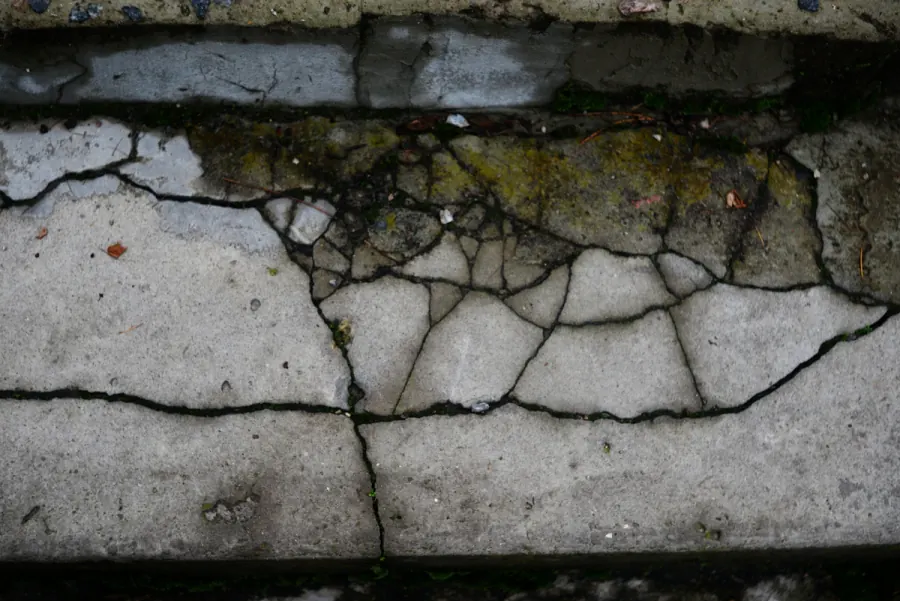
Cracks across the floor are usually a symptom rather than the problem. A slab spanning a void takes tension it was never designed for and cracks where the void ends. Lifting supports the slab again and stops the crack widening, but it will not close it. Anyone who tells you a lift makes cracks disappear is overselling.
A gap at the wall is the cleanest measurement of how far the slab has travelled. We measure it before and after, and seal the joint once the floor is back at grade so runoff and pests cannot use it as a path.
How we level a garage floor
Four to six hours on a typical two-car garage, worked bay by bay so the space stays usable throughout.
- 1
Shoot the floor and the door line
We laser the whole slab and record elevations at the door threshold, the wall lines and the centre. The door line matters most because that is where the apron meets the floor and where a step becomes both a trip hazard and a water entry point.
- 2
Check the slab edge and any wall gap
A gap between the slab and the wall tells us how far the floor has moved independently of the structure, which is the cleanest measurement of total settlement available. We also check for plumbing penetrations and post-tension cable layout before drilling anything.
- 3
Work in bays, not all at once
Ports are laid out bay by bay so the garage stays usable. Vehicles move across as we go, shelving stays put unless it sits over a port, and appliances are worked around. A typical two-car garage is sequenced into two or three working areas.
- 4
Fill the fill void
Garage pads are built on imported fill, so the cavity under a settled garage floor is usually larger than under a driveway. The opening injections consolidate that fill and fill the cavity before any lifting occurs. This stage takes the majority of the material on a badly settled floor.
- 5
Lift to grade and close the gap
The slab is raised in small increments with the laser running, working toward a floor that meets the door threshold correctly and closes the gap at the wall. On floors with a designed fall to a drain, we restore the fall rather than flattening it.
- 6
Patch, seal and hand back
Ports are filled with colour-matched compound, the slab and wall joint is sealed, and the floor takes vehicle traffic immediately. We hand over written notes on gutter, approach and threshold drainage that will refill the void if left as is.
Garage floor leveling cost in Lubbock
Lifting a garage floor costs $5 to $12 per square foot with polyurethane foam and $3 to $8 with mudjacking. Garage jobs sit slightly above driveway pricing per square foot because the void under imported fill is typically larger, working space is tight, and the sequencing around vehicles and fixtures takes time.
| Garage | Size | Foam injection | Replace slab |
|---|---|---|---|
| Single-car | 240 sq ft | $1,200 to $2,900 | $4,800 to $9,000 |
| Two-car | 400 sq ft | $2,000 to $4,800 | $8,000 to $15,000 |
| Three-car | 620 sq ft | $3,100 to $7,400 | $12,000 to $22,000 |
| Detached shop | 900 sq ft | $4,500 to $10,800 | $16,000 to $30,000 |
| Threshold and apron only | 80 sq ft | $600 to $1,300 | $1,800 to $3,200 |
Replacement figures include demolition inside a confined space and haul-off through the door opening, which is the main reason garage slab replacement costs more per square foot than an equivalent outdoor pour.
A bag of self-levelling underlayment fixes a surface irregularity, not a settling slab. If the floor is dropping because the fill underneath washed out, the overlay drops with it, and you have added weight and cost without addressing anything. Self-levelling compound is the right product for a floor that is flat but rough. It is the wrong product for a floor that is low.
What we check before drilling a garage slab
Three things get verified on every garage job before a bit touches the floor. First, slab thickness. Garage pads are usually four inches, sometimes more where a shop was planned, and occasionally less on older or owner-built construction. Under four inches, injection pressure becomes a risk rather than a tool.
Second, what is in the slab. Plumbing penetrations, conduit runs and, on some newer builds, post-tension cables all need to be located before a port pattern is set. A garage that shares a slab edge with living space gets the same treatment as interior slab work.
Third, where the water comes from. If the apron outside slopes back toward the door, or the gutter downspout discharges within a few feet of the threshold, the void will re-form no matter how well the lift is executed. That goes in the written scope with a recommendation, whether or not we are the ones fixing it.
Shop floors and heavy loading
Detached shops and garages used for vehicle work see loads a residential garage does not: a lift, a press, a trailer with a loaded axle parked in the same spot for months. Around Levelland in Hockley County, where the local economy runs on cotton, sorghum and petroleum production, farm and oilfield equipment parked on residential shop slabs is a routine cause of localised settlement. Those jobs get a tighter port pattern under the loaded area and a foam density chosen for the load, not the default.
Garage floor leveling questions, answered
Can a garage floor be leveled without replacing it?
Yes. A settled garage slab is lifted back to grade by injecting polyurethane foam through 5/8 inch ports drilled in the floor, at a typical Lubbock cost of $2,000 to $4,800 for a two-car garage. Replacing the same slab means demolition inside a confined space, haul-off through the door, new base, a new pour and a week of cure, at $8,000 to $15,000. The slab you have is almost always worth keeping.
How much does it cost to level a garage floor?
Leveling a two-car garage floor in Lubbock costs $2,000 to $4,800 with polyurethane foam, or $1,200 to $3,200 with mudjacking. A single-car garage runs $1,200 to $2,900 with foam. The range depends on how far the slab has dropped, how large the void underneath is, and whether the lift has to work around vehicles, shelving and a water heater.
What is the cheapest way to level a garage floor?
Mudjacking is the cheapest lifting method at $3 to $8 per square foot, and self-levelling overlay is cheaper still for very small height differences. Neither is automatically the right choice. Self-levelling compound only fixes the surface, so if the slab is dropping the overlay drops with it. Mudjacking adds 100 to 150 pounds per cubic foot of new load to soil that already failed. On a garage with a real void underneath, foam injection is usually the cheapest fix that stays fixed.
Why is my garage floor sinking?
Garage floors sink because water washed out the fill underneath, and garages are built on fill by design. The floor slab is poured over material brought in to bring the pad up to door height, which is looser than the undisturbed ground around it. Runoff from the roof and the driveway approach concentrates right at the door line, and Lubbock's sandy Amarillo and Acuff soils over caliche carry fines away readily during the few big storms that deliver most of the year's 19 inches.
Can a cracked garage floor be lifted?
Yes, if the panels are intact. A garage slab with one or two clean cracks lifts normally, with the port pattern adjusted so each fragment is supported independently. What cannot be lifted is a floor that has crumbled into many fragments, spalled through to the aggregate, or was poured too thin to hold injection pressure. Existing cracks stay visible after a lift; the elevation is corrected, the crack is not erased.
Do I have to empty the garage first?
No, and you do not need to move the vehicles out permanently either. We work in sections, so a two-bay garage can be lifted one bay at a time with the cars shuffled across. Shelving along the walls usually stays where it is unless it sits directly over a port location. Water heaters, softeners and freezers are worked around rather than disconnected.
How soon can I park on a lifted garage floor?
The same day, usually within the hour of the last injection. Polyurethane foam reaches roughly 90 percent of its strength about 15 minutes after placement and cures by chemical reaction rather than by drying, so nothing has to evaporate. Mudjacking the same floor would need 24 to 72 hours before vehicle loading.
Is a sinking garage floor a foundation problem?
Usually not, because in most Texas construction the garage slab is poured separately from the footings that carry the walls. The floor can drop several inches while the structure around it stays put, which is why you often see a gap open between the slab edge and the wall. It is still a signal worth reading: whatever moved the fill under the garage is water, and that water is running alongside the house foundation too.
What about the gap between my garage slab and the wall?
A gap at the wall line means the floor slab has dropped away from the structure, which confirms the failure is under the floor rather than in the footings. Lifting closes that gap by returning the slab to its original elevation, and the joint is then sealed so runoff and pests cannot use it. A gap that keeps reopening after a lift points to an ongoing water source at the door line that has to be redirected.
Get a quote on your garage floor
Tell us how far the slab has dropped and whether a gap has opened at the wall. We shoot the floor, check the threshold, and come back with a fixed price and a bay-by-bay plan so you keep the garage.
- Free written scope with a measured lift plan, not a verbal number
- Polyurethane foam on 5/8 inch holes, patched and colour matched
- Drive on the slab the same day, usually within the hour
- Insured crews, written workmanship guarantee on every lift